

97% of the 136,711 mobile apps NowSecure assessed show no detectable post-quantum cryptography (PQC) code. Security teams often leave mobile apps out of their cryptographic inventories, and organizations cannot migrate what they have not inventoried.
NowSecure used NowSecure Platform to check where mobile apps stand. We assessed those apps over the 90 days ending Oct. 5, 2026. Planning dates already exist: Google has set 2029 as its own PQC migration target, and federal agencies must move high-value systems to quantum-safe key establishment by Dec. 31, 2030.
What Is Q-Day, and Why Do the Dates Matter Now?
The exact date remains unknown, but migration milestones are already set for 2029 to 2031.
According to Gartner®, Q-Day is “the moment that state actors obtain a cryptographically relevant quantum computer (CRQC),” and “Q-Day arrives as soon as 2029, but most progress on PQC migration so far is inadequate.”¹ Gartner warns that such capabilities “threaten widely used public-key cryptography” and says the business risks include “harvest now, decrypt later”.¹
Harvest now, decrypt later is the most discussed of these risks, and it is a problem of time. Encrypted traffic intercepted today cannot be read now, but it can be stored and decrypted once a CRQC exists, which puts any data with a long shelf life, such as health records, financial history and credentials, at risk already. The less discussed risk is a problem of trust. Quantum-vulnerable public-key cryptography also underpins key establishment, authentication and code signing in systems operating today.
An adversary with a sufficiently capable quantum computer could attack those mechanisms to compromise new communications, impersonate trusted parties, or forge software signatures, not just decrypt previously captured data. Q-Day is therefore not only a historical-data problem: applications that still depend on vulnerable public-key cryptography would also face active threats to confidentiality, authenticity, and integrity.
Mobile applications sit squarely in both categories. They transmit sensitive data over diverse public cellular and roaming networks outside enterprise control, which heightens their exposure to “harvest now, decrypt later” tactics, a risk explicitly highlighted in joint migration advisories from CISA, NSA and NIST. They also depend on the same key exchange, authentication and code signing that a CRQC would break.
Google's security team published its 2029 migration timeline in March 2026, citing progress in quantum hardware and related research. A Global Risk Institute survey of 26 experts estimates a 28% to 49% chance that a cryptographically relevant quantum computer arrives within 10 years. The probability range cannot pinpoint a date. Because migration takes years, waiting for certainty could leave your organization short of time.
The timeline matters most where data must stay confidential for decades. “Whether a quantum computer exists today or not, the critical issue is how long the data we encrypt today needs to stay private. In defense, everything from ship and aircraft specifications to technical data outlasts the algorithms protecting it, and so do court records, health records and ownership deeds,” said Colin Gounden, CEO of VIA. “Given VIA’s work protecting mission-critical data across defense and law enforcement, we sought out NowSecure to independently assess the post-quantum readiness of our mobile solutions. Organizations can make that decision today.”
Federal deadlines add pressure. Executive Order 14412 directs agencies to move high-value and high-impact systems to quantum-safe key establishment by Dec. 31, 2030, and to quantum-safe digital signatures by Dec. 31, 2031. An Oct. 6 report from the U.S. Government Accountability Office found that none of 24 major federal agencies had fully addressed key PQC preparation practices, citing gaps in cryptography expertise and inventory processes. If agencies with a mandate are still building those capabilities, private organizations that start now can get ahead.
Security leaders recognize the same gap. Gartner warns that CISOs “must start postquantum cryptography (PQC) transition now or face doubling costs every year it’s delayed.”¹ Gartner’s 2026 survey of CISOs found that “45% of CISOs say their organization hasn’t begun any PQC-related activities, and another 39% are only in the planning and early testing stages.”¹
How Many Mobile Apps Show Post-Quantum Cryptography (PQC) Code?
NowSecure’s analysis of mobile apps using NowSecure Platform found the following:
- 96.9% of the apps we assessed (rounded to 97%) show no detectable PQC code.
- 4,241 apps (3.1%) show PQC-related code or libraries.
"Mobile apps are the most exposed and least inventoried part of an organization's encryption," said Alan Snyder, CEO of NowSecure. "Security teams can tell you what their servers use but often lack visibility into apps that handle intellectual property, personal data and financial transactions. NowSecure makes finding vulnerable cryptography easy, but coordinating fixes across developers and vendors takes time, so the work has to start now."
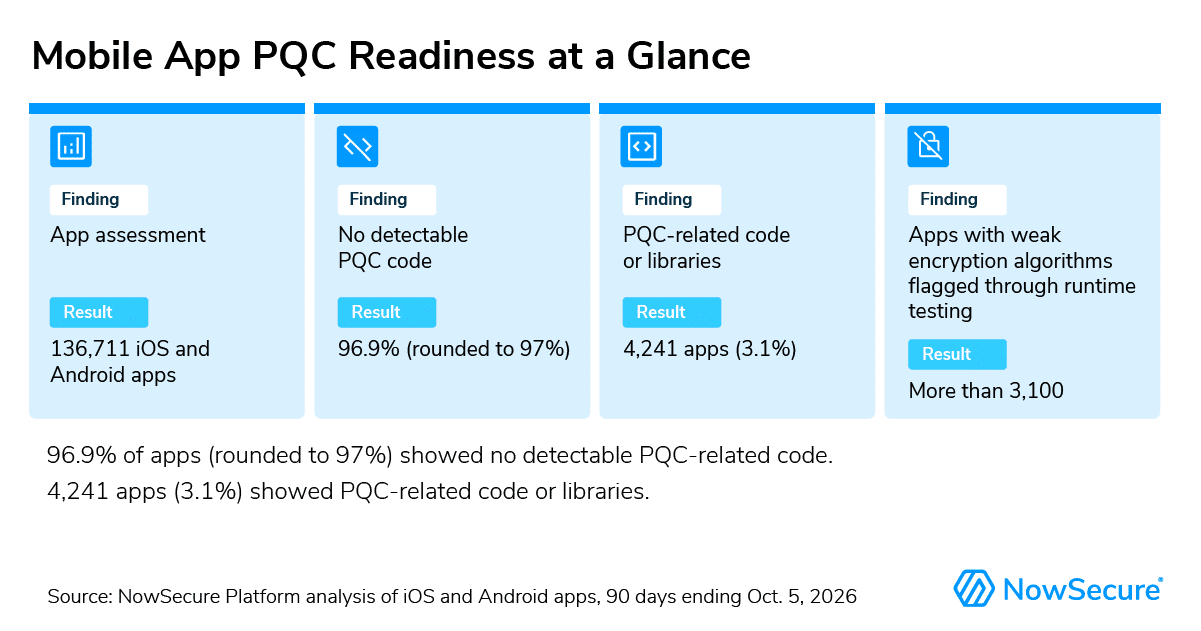
Mobile App PQC Readiness at a Glance
What Does a PQC Detection in a Mobile App Mean?
A PQC detection means PQC-related code or libraries ship inside the app binary. It does not show that the code runs.
Most mobile apps protect logins, payments and secure connections with public-key cryptography such as RSA and elliptic curve algorithms. A sufficiently powerful quantum computer is expected to break these asymmetric algorithms. PQC refers to newer algorithms built to withstand that attack. NIST finalized its first three PQC standards in 2024 (FIPS 203, 204 and 205), covering key establishment, the process systems use to exchange encryption keys, and digital signatures, which systems use to prove identity and integrity.
In the 90 days ending Oct. 5, 2026, NowSecure assessed 136,711 unique apps, counted by bundle ID or package name. An app on both the App Store and Google Play stores counts once per platform. The analysis used static inspection of app binaries to identify PQC-related algorithms, code or libraries. NowSecure flagged weak encryption algorithms through runtime testing. NowSecure Platform's PQC observation, available for Android and iOS, performs this check.
Detection gives security teams a starting point for deeper review. Static analysis does not confirm that the code runs, and an app can also draw protection from the operating system, network stack or server. Real-device testing and expert-led penetration testing confirm how cryptography behaves at runtime.
A lack of PQC code does not automatically mean an app's cryptography is currently at risk: symmetric cryptography (such as AES-256) and secure hash functions are inherently quantum-resistant. It is important to distinguish between quantum-vulnerable public-key algorithms, actual quantum-related exposure based on data shelf life and operational model and overall PQC readiness.
How Common Are Weak Encryption Algorithms in Mobile Apps?
Using runtime testing, NowSecure flagged weak encryption algorithms in more than 3,100 Android and iOS apps during the same study. These checks detect legacy algorithms such as DES and RC4.
Weak encryption algorithms in mobile apps pose an immediate security concern, independent of quantum computing. Addressing them now gives development teams practical experience with approved cryptographic libraries, certificate processes and testing. The findings highlight the need to address existing encryption weaknesses while identifying and migrating public-key cryptography vulnerable to future quantum attacks.
Why Are Mobile Apps Missing From Crypto Inventories?
Third-party libraries and SDKs supply much of an app's cryptography. Developers may not have written that code, and it may not be visible in their source. Source scans and dependency lists can miss what ships in the finished app, so inspect the build users download.
Effective mobile app risk management starts with visibility into the software your organization builds and uses. A complete cryptographic inventory should cover first-party and third-party apps, including the libraries and SDKs embedded in each build. This gives security teams a stronger basis for prioritizing PQC migration and addressing existing cryptographic weaknesses.
A Two-Year PQC Migration Plan
We recommend a minimum two-year plan. Use the first phase to inventory and assess your mobile cryptography, then run a cycle of remediation and retesting. The size and overhead of the new PQC algorithms will affect performance and architecture in first-party apps, while third-party components and apps require substantial coordination, remediation and testing. Follow three steps across the apps you build and the apps you depend on:
- Inventory and prioritize all cryptography in first-party and third-party mobile apps, including the third-party SDKs and libraries inside them, starting with what protects personal data, intellectual property, financial transactions and other sensitive data.
- Remediate your first-party apps. For third-party apps, ask each vendor for its PQC plan, build a plan with the vendor or move to a PQC-ready alternative.
- Retest the remediated PQC algorithms, components and apps.
How NowSecure Helps with Mobile PQC Migration
NowSecure Platform analyzes finished Android and iOS apps to identify PQC-related code, surface weak or outdated cryptography and flag third-party components for investigation. Real-device testing and expert-led penetration testing then confirm how that cryptography behaves at runtime.
How to Start a Mobile Cryptographic Inventory This Quarter
- Name an owner for the inventory, usually your AppSec lead.
- List every mobile app in scope, including apps your vendors supply, and inspect the finished binaries for the algorithms, libraries and SDKs they contain.
- Rank the apps by the sensitivity of the data they handle.
- Have procurement ask your top vendors in writing when they will ship PQC support and in what form.
- Set a first-phase goal, such as every in-scope app inventoried and ranked by October 2027.
- Review progress each quarter.
Join NowSecure's Scott Cogan and Michael Krueger on Oct. 21 at 1 p.m. ET for The Mobile Gap in Your PQC Plan, a 45-minute webinar on why mobile apps are harder to inventory and which PQC myths to avoid.
Gartner Attribution and Disclaimer
1 Gartner, “CISO Agenda Priority: Transition to Postquantum Cryptography Before It’s Too Late (And Too Expensive),” Mark Horvath, Sarah Almond, Thomas Lintemuth, 17 September 2026.
GARTNER is a registered trademark and service mark of Gartner, Inc. and/or its affiliates in the U.S. and internationally and is used herein with permission. All rights reserved.