Cybersecurity Awareness Month usually brings a familiar set of reminders: strengthen passwords, turn on multifactor authentication, update software and watch for phishing. Each helps. None goes far enough for organizations whose customers, employees and revenue increasingly depend on mobile applications.
The mobile security conversation changed materially in 2026. Enterprise mobile portfolios already include AI. Apple’s iOS 27 allows Siri AI to retrieve information and invoke actions inside apps without the user opening them. Google advances a similar model through Android AppFunctions, which lets privileged agents discover and call app capabilities on the device.
Mobile apps now do more than wait for a person to tap the screen. They increasingly participate in an agentic ecosystem in which data and actions can move across apps, models and services. That creates real opportunity for better customer experiences. It also expands the security boundary beyond the app itself.
Here are seven realities security and development leaders need to understand now.
1. Mobile drives business operations, but many security programs still treat it as a secondary channel
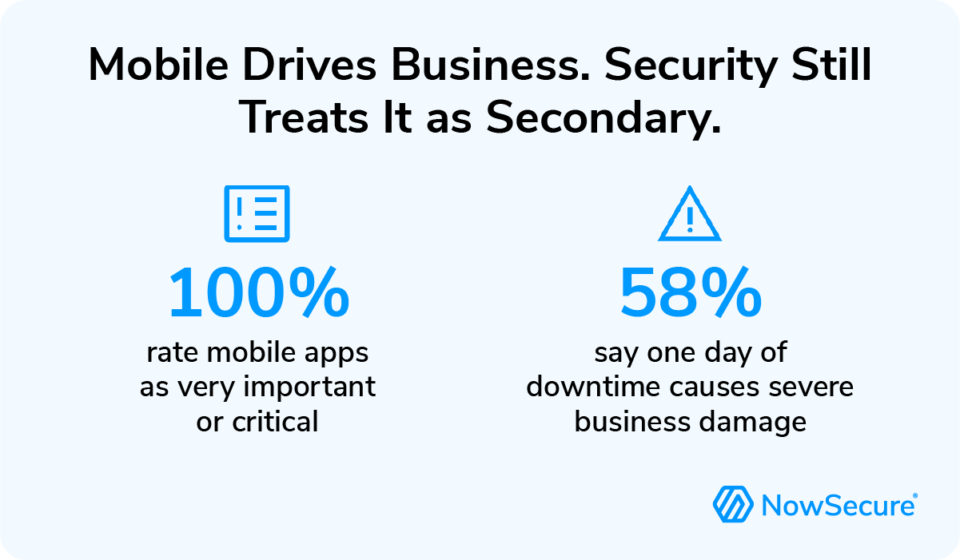
The gap starts with business impact. In the NowSecure 2026 Mobile App Risk Management Survey, every respondent rated mobile apps as very important or critical to the business. 58% said a single day of app downtime would cause severe business damage.
That makes mobile security an operational and revenue concern. Its impact extends beyond the application security program. An app that processes payments, opens accounts, manages healthcare interactions, supports travel or connects customers to a brand supports the company’s operating model. Security teams should measure its risk accordingly.
Mobile App Risk Management (MARM) starts with a practical question: Do testing depth and frequency reflect what each app does for the business? A customer-facing banking app and an internal event app should not sit in the same business-impact tier or follow the same mobile application security testing schedule.
2. AI is already inside mobile apps, whether governance has caught up or not
AI adoption does not wait for security programs to mature. In the NowSecure survey, 95% of organizations say they deploy AI in mobile apps, while 37% said they do not monitor AI behavior in the apps they develop and deploy.
That visibility gap can take several forms. Teams may not know which apps contain embedded models, connect to external AI services, include AI-enabled SDKs or expose sensitive data to model providers. AI-generated code can also enter the mobile codebase faster than security teams can review it, bringing familiar software weaknesses along with less familiar questions about model behavior and data handling.
An AI policy does not answer those questions. Security teams need a verifiable inventory of the AI actually present in shipped applications, the data it can access, where apps and connected services process that data and how those behaviors change over time.
3. iOS 27 moves application risk beyond the app.
Apple’s iOS 27 introduces a more consequential shift. Siri AI can use App Intents to retrieve information and invoke supported actions on a user’s behalf, even when the user never opens the app. Apple describes Siri AI as having personal context, onscreen awareness and systemwide app actions. For product teams, that opens a new path to customer engagement. For security teams, it means the app no longer controls the entire interaction.
The agent lives outside the app. Context may come from messages, calendars, content on the screen or another application. Siri AI can then use the actions an app has exposed to complete a broader workflow. An individual action may look legitimate in isolation while the full sequence creates an outcome the developer did not anticipate.
NowSecure found that 24% of apps tested from June through August 2026 had functionality potentially exposed to Siri AI and Apple Intelligence. App Intents are not new, so some organizations may already have exposure before product and security leaders make an explicit decision about participating in Siri AI workflows.
This is not an argument for opting out. Being absent from AI-mediated customer journeys may carry its own business cost. Security teams should identify exposed actions, apply the appropriate authentication and ownership controls and test how those actions behave inside complete agentic workflows.
4. The shift extends beyond Apple.
Treating iOS 27 as an Apple-specific event would miss the larger market direction. Google’s Android AppFunctions allows applications to expose type-safe, sandboxed capabilities that a privileged agent can discover and invoke locally. Google describes the app as operating like a local MCP server, making its capabilities available to the device’s intelligence system.
The implementations differ, but they share a security implication: agents can invoke mobile functionality outside the app’s conventional user interface. Authentication, authorization and input validation still matter, but teams must also understand which capabilities agents can discover, what context informs an agent’s decisions, how agents can chain multiple actions and which actions require user confirmation.
An effective security model cannot be built separately for every assistant. Organizations need a cross-platform approach to inventorying agent-accessible functions, classifying high-risk actions and validating complete workflows across iOS and Android.
5. Third-party code has become part of the AI and privacy attack surface.
Mobile applications contain far more than first-party code. 68% of survey respondents reported that at least half of their mobile codebase consists of third-party SDKs and libraries.
Those components can collect sensitive information, introduce vulnerabilities, connect to outside services and change between releases. Add AI SDKs, model libraries and analytics services, and the organization may have several layers of data movement that source review alone cannot easily reveal.
Privacy, supply-chain risk and AI governance converge here. A team may approve one set of fields for one provider, only to have a later SDK or workflow send additional data somewhere else. A static software bill of materials helps establish which components the app contains. It does not show everything the app does at runtime.
Security teams need both: an accurate inventory of components and dynamic evidence of how the app behaves on a real device, including what data it collects, where it sends that data and whether those flows match policy and public disclosures.
Security teams need a verifiable inventory of the AI actually present in shipped applications, the data it can access, where apps and connected services process that data and how those behaviors change over time.
6. Periodic testing cannot keep pace with continuously changing applications.
Mobile applications change quickly. Operating systems change. SDKs update. AI-generated code accelerates development. App Intents and AppFunctions expose new capabilities. Model endpoints and data flows can shift without a visible change to the customer experience.
Testing once before launch, once a quarter or only before an audit captures a moment in time. It does not provide control over a living application portfolio. The NowSecure survey found that 96% of organizations testing only some of their apps reported experiencing a mobile app security incident. That result does not prove testing coverage was the only cause, but it does expose the risk of leaving portions of a portfolio unexamined.
Teams can keep development moving by making security testing part of the release process, with testing depth based on business impact. Automated analysis can cover every build and release, while expert-led penetration testing can focus on high-risk applications and complex workflows that require human judgment.
AI can help security teams operate at that speed, but it needs grounding. NowSecure’s work with AI-native mobile testing combines AI reasoning with binary evidence, real-device runtime data and specialized mobile security expertise. The distinction matters. A plausible answer from a general model is not the same as a validated finding tied to evidence a developer can act on.
7. Mobile security standards are becoming more actionable.
The mobile security standards landscape took an important step forward in 2026. OWASP released MASTG v2.0 and the first stable version of the Mobile Application Security Weakness Enumeration, MASWE v1.0.
MASVS defines the security controls an application should meet. MASWE names the specific weakness when a control fails. MASTG provides the tests used to verify it. Together, they create a stronger line from security requirement to identifiable weakness, reproducible test and remediation evidence.
For security and compliance leaders, this goes beyond taxonomy. A developer can fix a specific weakness more readily than a broad control failure. An auditor can follow the evidence. A CISO can compare risk across applications using a consistent vocabulary.
Standards will continue to evolve as agentic mobile workflows mature. Teams should use the current OWASP framework as a baseline while extending threat models and testing to cover App Intents, AppFunctions, AI-driven data flows and actions that cross application boundaries.
Turn Awareness Into Evidence
Cybersecurity Awareness Month should create more than attention. It should force a clearer view of where business dependency and security visibility have drifted apart.
Start with six questions:
- Which mobile apps contribute most to revenue, customer access and operations?
- Which apps contain AI models, AI-enabled SDKs, generated code or connections to outside model providers?
- What App Intents or Android AppFunctions expose application data and actions to agents?
- Which third-party components can access sensitive information, and what do they do at runtime?
- Do teams test high-risk apps on real devices with every release, or only at fixed intervals?
- Can teams trace every material finding to reproducible evidence, a recognized standard and a clear remediation path?
If the answers are incomplete, the issue is not a lack of awareness. It is a lack of visibility.
NowSecure helps organizations see, secure and govern the mobile applications they build and use, including the AI components, third-party code, App Intents, vulnerabilities and sensitive data flows that traditional application security tools can miss. Request a demo to see what is inside your mobile apps and how they behave on real devices.