Mobile Application Risk Management
Govern the risk inside every mobile app your business depends on
NowSecure gives enterprises continuous, evidence-based visibility into the security, privacy, compliance, and AI risk inside the mobile apps they build, use, and manage. Every finding is grounded in what shipped apps actually do, on real devices, at runtime.

Classify risk
Test continuously
Route remediation
Report with evidence
The Stakes
Why Mobile App Risk Is Business Risk
For most enterprises, the mobile app is no longer a channel. It is the revenue engine, the customer relationship, and the operational backbone. And mobile carries risks the web never did: shipped binaries anyone can download and reverse-engineer, devices that get lost or infected, and connections over networks you do not control. Every mobile app that interacts with your organization, whether built, used, managed, or installed on BYOD devices, can become a gateway to sensitive data. When that gateway is breached, abused, or pulled from the store, the consequences land on the business, not the backlog.
- Revenue interruption: When the app goes down, transactions stop. Downtime on a primary revenue channel is measured in dollars per minute, not tickets per sprint.
- Fraud against your customers: Attackers repackage cloned apps, overlay fake screens, and steal credentials to commit fraud in your name. The losses and the liability come back to you.
- Regulatory & legal exposure: Data leaks trigger fines, breach-notification obligations, and litigation, with liability that reaches the executive team and the board.
- App store removal: Platform policy violations can pull the app from distribution overnight, cutting off customers until issues are remediated and re-reviewed.
- Customer trust erosion: Users who lose confidence in an app's handling of their data rarely announce it. They quietly leave and take lifetime value with them.
Five questions every organization should be able to answer
- What apps are in our portfolio?
- What sensitive data do they collect, store, and share?
- Which third parties, SDKs, APIs, and AI services do they rely on?
- Which apps carry the highest business impact?
- Can we prove controls are working when leadership, auditors, or regulators ask?
Organizations with a program testing all of their mobile apps were 3-times less likely to experience a Major Mobile App Security incident (2026 Mobile App Risk Management Survey)
The exposures traditional mobile app programs miss
Mobile risk often starts where traditional AppSec, endpoint, cloud, and compliance tools have limited visibility: compiled binaries, third-party SDK behavior, runtime data flows, unmanaged apps, and AI services embedded inside mobile experiences. Mobile Application Risk Management (MARM) exists to close those visibility gaps before they become business events.
The EXPOSURES

Undetected data leakage is the highest-consequence mobile risk
The most common mobile data risk is not always a dramatic breach. It is quiet movement: identity, location, device identifiers, credentials, health data, financial data, or behavioral data flowing to destinations no one reviewed. NowSecure shows where that data goes, which third parties receive it, and whether the behavior creates security, privacy, compliance, or AI governance risk.

The shipped binary contains risk your reviews may never see
Most enterprise mobile apps depend heavily on third-party SDKs, libraries, APIs, and embedded services. By the time the app ships, much of that risk lives inside the compiled binary, beyond what source-code review alone can explain. NowSecure analyzes the shipped app itself, so teams can see what actually made it into production.

Point-in-time testing leaves change unverified
Point-in-time testing captures risk at a single moment, but quickly goes stale. With roughly 77% of top iOS and 75% of Android apps updated monthly, and nearly all annually, snapshots lose relevance fast. Frequent releases introduce new code, SDKs, and APIs that can quietly create vulnerabilities. A single test result is valid only for that specific version, not a durable guarantee. To keep pace with rapid development, continuous or embedded testing is essential, replacing one-and-done pen tests.

Regulators now expect evidence, not intent
Security, privacy, AI, and cyber reporting obligations increasingly require organizations to prove how risk is governed. For mobile apps, that proof depends on a living record of what apps do, what data they touch, what third parties they contact, and how findings are prioritized, remediated, or accepted.

Release velocity compounds every other exposure
Each new release is another chance for data to leak somewhere unreviewed, another round of third-party SDKs baked into the shipped binary beyond what code review sees, and another gap between what was last tested and what's actually running in production. Since regulators expect a living record of app behavior, not a one-time snapshot, faster releases mean that evidence goes stale faster too, so leakage, hidden binary risk, and outdated test results all compound with every cycle.
The Functions
What Mobile Application Risk Management governs
Mobile Application Risk Management brings four risk domains into one operating model:

security risk

privacy risk

third-party or supplier risk

compliance risk
AI risk now cuts across all four because models, SDKs, agents, and inference services increasingly live inside mobile apps.
Why Now
Why mobile risk management has to change now
The apps have changed faster. Enterprise mobile apps now ship continuously, rely heavily on third-party code, and increasingly include AI capabilities that affect data collection, processing, and sharing. A quarterly review cannot govern a risk surface that changes every release.
The Program
How do you build a mobile application
risk management program?
The new shape of mobile app risk management is continuous, evidence-based, and proportioned to business impact, governing security, privacy, safety, compliance, and AI risk in one program. Each step feeds the one after it, turning raw findings into decisions the business can act on and leadership can stand behind.

Classify business impact
Define which apps matter most based on data sensitivity, user volume, business function, regulatory exposure, and operational dependency.
See the tier rubric below.

Inventory the
portfolio
Maintain a living catalog of apps, SDKs, APIs, AI components, data destinations, and ownership across the mobile estate.

Assign Mobile Apps to Impact Tiers
Match testing depth and frequency to business impact, from continuous automated assessment to authenticated dynamic testing and adversarial analysis.
Testing depth follows the progressive ladder.

Remediate and report with evidence
Route findings to the right owners, verify fixes, and give leadership an evidence-based view of mobile risk posture.
The Tiers
Business impact tiers make risk
management operational
Not every app needs the same level of scrutiny. Mobile Application Risk Management (MARM) uses business impact tiers to determine how often each app is assessed, how deep testing should go, who owns remediation, and what evidence leadership needs.
| Tier | What it means | Type of mobile app data | Recommended risk management approach |
|---|---|---|---|
| Tier 1 High Business Impact | Business critical. Significant damage if disrupted. |
|
|
| Tier 2 Medium Business Impact | Important for business operations. Moderate damage if disrupted. |
|
|
| Step 3 Low Business Impact | Informational. Minimal damage if disrupted. |
|
|
What puts an app in the high tier?
An app belongs in the high-impact tier when it handles sensitive data, supports core business functions, reaches large user populations, connects to critical APIs, creates regulatory exposure, uses surveillance-like device permissions, or includes AI functionality that touches customer, employee, or business data.
Tiers, data types and recommended approaches as published by NowSecure in its step-by-step guide to mobile app risk management.
The Policy
What should be included in a mobile app risk management policy?
Build
Mobile apps proprietary to your organization and used by employees, partners and customers to conduct business
Buy
Commercially available mobile apps from outside vendors.
Personal
Mobile apps on employees' devices and the enterprise network not owned by the organization.
Supplier
Mobile apps in the organization's supply chain stemming from vendor relationships.
A policy fixes four things for every app category and tier
ASSESSMENT FIDELITY
automated, manual or both
APP COVERAGE
auth, MFA, critical workflows
FREQUENCY
every build, every version, quarterly, annually
ACTIONS
remediate, mitigate, accept, deny, escalate, disclose, test further
Sample policy
| High Business Impact | Medium Business Impact | Low Business Impact | |
|---|---|---|---|
| Periodic Pen Testing | Annual | Annual | Not required |
| Critical Workflow Analysis | Every quarter | Twice a year | Not required |
| Continuous Automated Security and Privacy Analysis | Ongoing | Ongoing | Ongoing |
| Continuous Training | Security and development teams | Security team | Not required |
An illustrative policy shape published by NowSecure, not a NowSecure customer benchmark. Your own thresholds are set when you define your tiers.
Delivered By
Delivered through the NowSecure platform
and services
NowSecure delivers Mobile Application Risk Management (MARM) through a connected set of capabilities: portfolio inventory, business-impact tiering, automated and expert-led testing, third-party app risk intelligence, AI component discovery, remediation workflows, and executive reporting. Together, they create one continuous cycle for governing mobile app risk.
How It Works
How the Mobile Application Risk Management cycle runs continuously
Every new app, release, SDK update, policy change, or AI component can change risk. The Mobile Application Risk Management (MARM) cycle keeps the program current: classify the app, test to the right depth, route remediation, verify fixes, and report posture back into the business.
Build apps are the apps you build; Buy, Personal, and Supplier apps are the apps you use.

Risk
Classification
Every app is inventoried, threat modeled, and assigned a risk tier. Apps carrying embedded AI models, agents, or inference SDKs are flagged as a distinct risk factor. That tier determines how deep and how often testing runs.

Progressive
Testing
Testing scope spans the apps you build and the apps you use, including third-party app vetting. Depth scales by risk tier across DevSecOps, business risk, privacy compliance, adversarial, and investigative testing, plus third-party application risk intelligence.

Orchestrated Remediation
Findings route automatically through integrations and notifications. AI-assisted triage and fix guidance is tied to binary evidence, not a black box, so teams can trust it. Embedded developer guidance and retesting confirm every fix actually closes the issue.

Compliance and Report
Portfolio health, management benchmarks, and compliance mappings roll up into one continuous view, measured against standards like OWASP MASVS. Every AI-assisted action produces the evidence-linked, audit-ready log that AI governance frameworks increasingly require.
Close the Mobile App Gap in these programs
AI Attack Surface
Reduction
Continuous
Exposure Management
App Posture
ASPM
AI Posture
AI-SPM
Endpoint Protection
Mobile Device Management
ASPM: application security posture management. AI-SPM: AI security posture management.
The Method
Why evidence beats inference
Traditional tools observe only part of the mobile app. SAST reviews source code. SCA reviews known components. Point-in-time pen tests capture one moment. AI-only scanners infer likely behavior. NowSecure observes what the shipped app actually does through correlated binary, dynamic, and behavioral analysis on real devices, including authenticated workflows and runtime data flows.
| Traditional tools | AI-only assessment | NowSecure correlated testing |
|---|---|---|
| SAST reads code but not runtime behavior | NoInfers likely behavior from patterns and metadata | YesBinary, dynamic, and behavioral analysis executed on real devices, behind real logins |
| SCA reads manifests but not SDK behavior | NoNo real-device execution, no authenticated session, no runtime data-flow observation | YesThree-stage correlated analysis (static binary findings, dynamic real-device execution, and observed runtime behavior cross-validated against each other) raises signal and cuts false positives |
| Pen testing is periodic, not continuous | NoConclusions are predictions, not evidence, and predictions can't be carried into an audit or a board report | YesAuthenticated testing surfaces 78% more sensitive-data findings per scan (7.23 versus 4.07) |
| YesAI accelerates navigation and correlation, with every finding grounded in observed evidence |
An AI-only assessment infers what an app probably does. NowSecure observes what the app actually does, on real devices, behind authentication, at runtime, and then uses AI to accelerate and correlate that evidence. Inference vs. evidence.
Testing depth scales with business impact

Level 1
Continuous automated baseline
For every app in the portfolio

Level 2
Authenticated dynamic testing
For every app in the portfolio

Level 3
Expert-guided testing
For business-critical functions

Level 4
Full adversarial PTaaS
For the apps the business cannot afford to lose
Pipeline Integration
Built into the way mobile app security teams ship
NowSecure integrates into CI/CD, binary upload workflows, ticketing systems, vulnerability response, GRC, MDM, and reporting processes so mobile risk management runs with the release cycle instead of after it. Findings include context, ownership, remediation guidance, and verification when fixes ship.
Looking to feed mobile risk intelligence into your broader security stack, including MDM and EDR? That's the intelligence story.
Coverage Scope
Covers every app category the
business depends on
Across these categories, NowSecure supports iOS, Android, OTT, mobile APIs, SDKs, and AI-enabled components.

Build
First-party apps your teams develop.

BUY
Commercial apps used by the organization.

Personal
Apps on employee devices that may touch corporate data or networks.
Supplier
Apps connected to vendor, partner, or supply-chain relationships.
Who Runs the Program
Built for the teams that own mobile risk
AppSec & DevSecOps Leaders
AppSec and DevSecOps use Mobile Application Risk Management to test continuously and remediate faster.
CISO & Security Leaders
CISOs use it to govern mobile risk as a business exposure.
Privacy & Compliance Leaders
Privacy and compliance teams use it to prove controls and reduce unauthorized data sharing.
EUC & Third-Party Risk Leaders
EUC and third-party risk teams use it to evaluate the apps employees and suppliers bring into the environment.
Pipeline Integration
Proven at enterprise scale
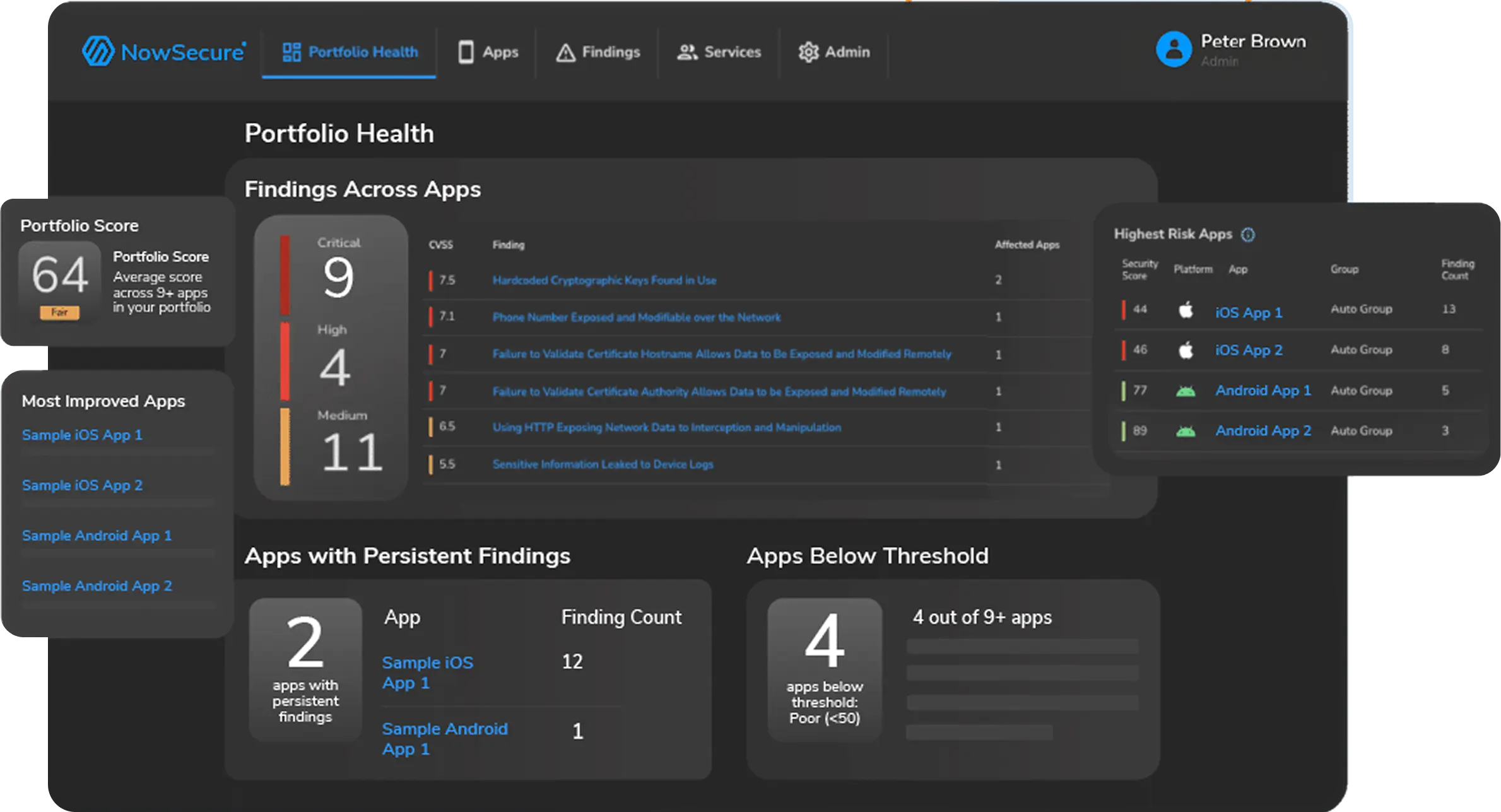
NowSecure has run millions of mobile app assessments, identified millions of vulnerabilities, completed thousands of mobile penetration tests, and supported leading enterprises and government agencies with evidence-based mobile app risk management.
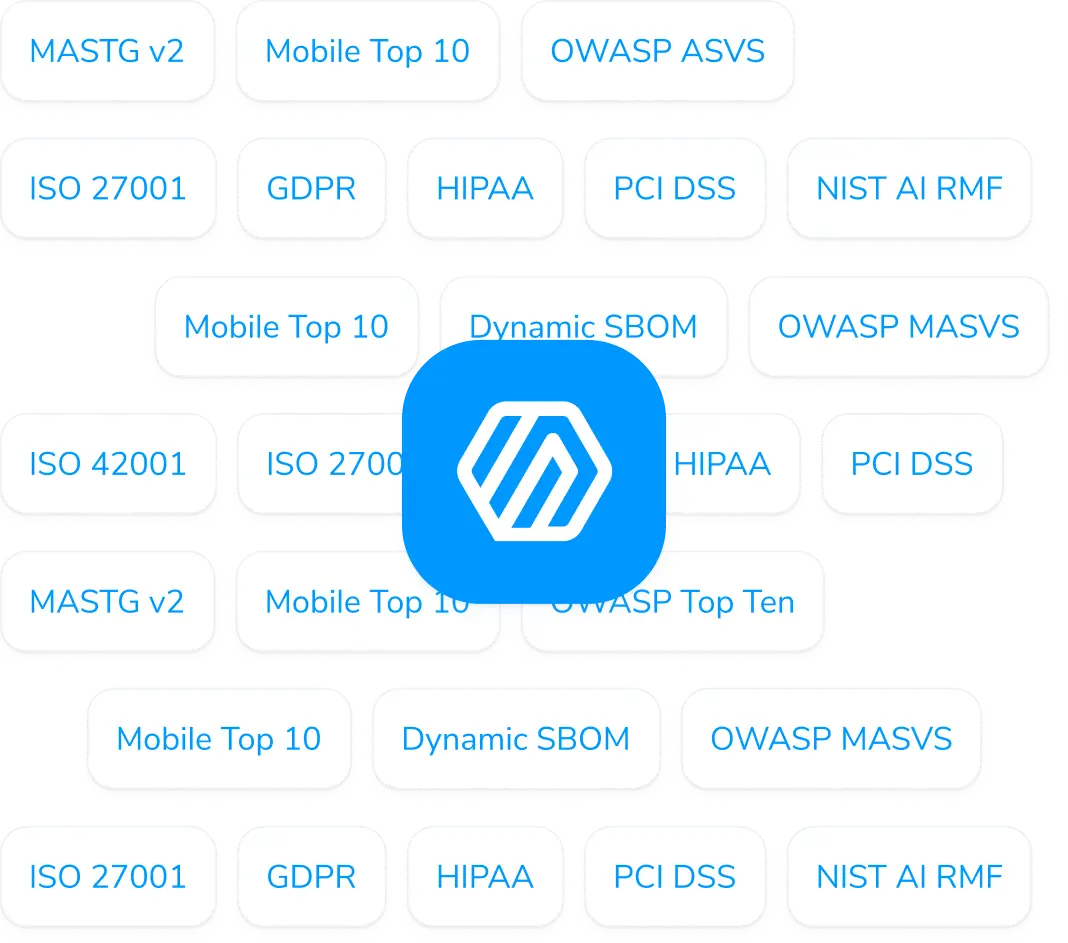
ISO/IEC 17025:2017 accredited · Coverage across all eight OWASP MASVS domains · Assessments mappable to HIPAA, GDPR, CCPA, and other regulatory frameworks




2026 Mobile App Risk Management Survey
What 485 senior security leaders across finance, healthcare, high tech, and retail report about mobile app risk, plus the strategic recommendations to close the gap.
The Bigger Picture
Where Mobile Application Risk Management
fits in the NowSecure portfolio
Mobile Application Risk Management is the operating model for governing mobile app risk across the portfolio. Mobile Application Security Testing provides the evidence engine. AI Security goes deeper into models, SDKs, agents, and AI-driven data behavior. Intelligence extends mobile risk visibility into the tools and teams that need it across the enterprise.

Goes Deeper
AI Security
Find, inventory, and govern hidden AI inside mobile apps before it creates security, privacy, or compliance risk.

This Page
Mobile Application Risk Management
The program: inventory, testing, prioritization, remediation, and reporting for every app you build, use, and manage.

Extends Outward
Intelligence
Mobile risk intelligence delivered into the security platforms that need mobile visibility: MDM, EDR, Mobile Threat Defense, Threat Intelligence, EASM, and AI governance tools.
See and govern the AI inside your mobile apps
Get a clear view of the AI, SDKs, generated code, and data flows inside your apps, plus prioritized guidance your teams can use to reduce risk and move faster.
Resources
Mobile Application Risk Management Resources