
NowSecure Platform
The platform for mobile application risk management
NowSecure gives enterprises continuous visibility into the security, privacy, AI, compliance, and supply chain risk inside the mobile apps they build, use, and manage. Test compiled binaries on real devices, uncover runtime behavior, and operationalize findings across development, security, governance, and partner workflows.
What you're accountable for
You're accountable for code
your team never wrote
Third-party SDKs, embedded AI, and behavior that only appears at runtime all compile into the app your customers run. They behave however their authors decided they should, and the consequences land on you regardless of who wrote them.

SDKs your team never wrote
Most enterprise apps are majority third- party code. That code compiles into the binary and behaves however its vendor decided it should.

AI nobody inventoried
Model call-sites, inference endpoints, and AI-connected dependencies ship inside apps without appearing in any governance record.

Data flows source review can't show
Where data actually goes is a runtime
property. It's observable on a device, not derivable from a repository.

Behavior that starts after login
The sensitive workflows (payments, records, account changes) sit behind authentication, where unauthenticated testing never reaches.
Every release is a new artifact
An SDK bump or dependency change alters the shipped binary. A quarterly review can't govern a surface that changes weekly.
Store approval isn't a security audit
Apple and Google enforce platform policy and basic malware controls. Neither reviews your data handling, crypto, or SDK behavior.
The Gap
You already run AppSec. Here's the blind spot every tool in it shares.
Each of these programs was built for something else, and each does that job well. None of them inspects the compiled artifact executing on a real device, which is where the most consequential mobile risk lives.
| What a Shipped Mobile App Needs Checked | SAST Source scanning | SCA Declared components | Pen Test Annual, point in time | AI-Only Pattern inference | NowSecure Continuous |
|---|---|---|---|---|---|
| Inspects the compiled binary that ships |  |
 |
 |
|
|
| Reveals how third-party SDKs actually behave | |
|
|
|
|
| Finds AI components and their endpoints | |
|
|
|
|
| Executes on real physical devices | |
|
|
|
|
| Reaches screens behind authentication | |
|
|
|
|
| Observes where data actually goes | |
|
|
|
|
| Corroborates findings across two techniques | |
|
|
|
|
| Repeats automatically on every release | |
|
|
|
|
Covered
Partial
Not Covered
Read the columns, not just the rows. Source scanning, SCA, and AI-only tooling run on every release but stop at the surface. A penetration test reaches real depth, then waits a year while the app changes weekly. Coverage assumes typical enterprise deployments; individual tool configurations vary. SAST, SCA, and periodic pen testing all remain necessary. Platform answers the question none of them is built to answer: what does the released artifact actually do?
See what a Proof-of-Value surfaces in an app you already ship
NowSecure Platform turns mobile app analysis into evidence your development, security, governance, and partner teams can use.
The method
How Platform sees inside the shipped app
Four stages, run automatically on every build. Each stage produces an artifact the next stage reasons over, which is what makes the final finding traceable rather than asserted.

Binary analysis
Decompile and inspect the compiled app: dependencies, third-party SDKs, AI call-sites, endpoint registrations, resilience controls.

Real-device execution
Run the app on real physical hardware through authenticated workflows. Observe network behavior, storage, permissions, data movement.

Correlation
Cross-validate static flags against observed behavior. Corroborated findings rise. Findings runtime can't reproduce get down-ranked.

Evidence artifact
Each finding is stored with its decompiled code, data-flow trace, and runtime capture, reviewable by an engineer or an auditor.
![[WEB] New Platform page graphics-The method section FINAL _Binary Analysis](https://www.nowsecure.com/wp-content/uploads/2026/08/WEB-New-Platform-page-graphics-The-method-section-FINAL-_Binary-Analysis-scaled.png "[WEB] New Platform page graphics-The method section FINAL _Binary Analysis")
Binary analysis
What compiled in, not what was committed
NowSecure decompiles Android and iOS binaries to identify what actually made it into the release, including components that never appear in your repository.
- Third-party SDKs, compiled dependencies, and their versions
- AI model call-sites, inference endpoints, and endpoint registrations
- Code-level weaknesses and resilience controls in the shipped artifact
Authenticated dynamic testing
The findings live behind the login
Platform runs eligible apps on real physical devices through authenticated workflows, because the screens that handle sensitive data are the ones a login protects.
- Real hardware, not emulators: device-specific behavior is part of the result
- Post-login network traffic, storage writes, and data destinations captured live
- Test-account provisioning is a defined step
![[WEB] New Platform page graphics-The method section FINAL _Auth Dynam tessting](https://www.nowsecure.com/wp-content/uploads/2026/08/WEB-New-Platform-page-graphics-The-method-section-FINAL-_Auth-Dynam-tessting-scaled.png "[WEB] New Platform page graphics-The method section FINAL _Auth Dynam tessting")
![[WEB] New Platform page graphics-The method section FINAL _Correlation](https://www.nowsecure.com/wp-content/uploads/2026/08/WEB-New-Platform-page-graphics-The-method-section-FINAL-_Correlation-scaled.png "[WEB] New Platform page graphics-The method section FINAL _Correlation")
Correlation
False positives are a mechanism problem, not a promise
Most vendors claim low false positives. Platform gives you the mechanism instead: two independent analyses have to agree before a finding is escalated.
- Static flag confirmed by runtime behavior → substantiated, prioritized
- Static flag runtime can't reproduce → down-ranked, out of the triage queue
- Every finding records which technique produced it, so triage is auditable
MCP Rule Creation
An inventory built from the binary, not from a manifest
Platform produces a CycloneDX mobile SBOM extended with an AI layer, assembled from what the analysis observed in the shipped app rather than from what was declared at build time.
- Components, SDKs, and libraries found in the compiled artifact, including ones your declared SBOM missed
- AI SDKs, embedded models, AI APIs, and AI-generated code identified in the binary
- Observed data destinations attached to each component, not inferred from documentation
![[WEB] New Platform page graphics-The method section FINAL _MCP rule creation](https://www.nowsecure.com/wp-content/uploads/2026/08/WEB-New-Platform-page-graphics-The-method-section-FINAL-_MCP-rule-creation-scaled.png "[WEB] New Platform page graphics-The method section FINAL _MCP rule creation")
AI is arriving in mobile apps faster than the review process meant to catch it.
Survey Evidence
Self-reported maturity didn't predict outcomes. Testing coverage did.
65% rated their own programs advanced, yet incident rates held flat across every maturity level. One variable did separate them: how much of the portfolio gets tested before release.
Major incident rate by share of the mobile app portfolio tested before release
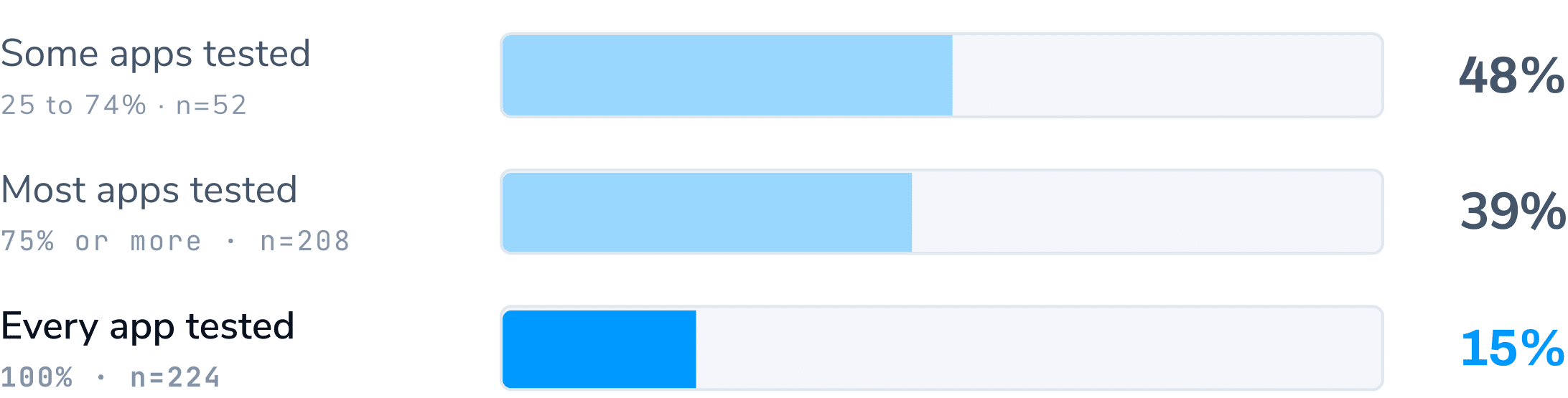
Only 46% of organizations test every app before release. Partial coverage is rarely a decision anyone made deliberately. It's what happens when testing is slow enough or manual enough that it has to be rationed, so the apps nobody flagged as important quietly go untested.
Major incidents were roughly three times as common at organizations testing only part of their mobile portfolio as at those testing every app before release.
Evidence vs. inference
An AI-only scan predicts what an app probably does. Platform observes what it did.
AI-only tools are genuinely fast, and speed has real value early in a pipeline. The distinction that matters is what you can carry into an audit or a board report, and a prediction isn't evidence.
| What It Evaluates | Source-Only / SAST | AI-Only Assessment | NowSecure Platform |
|---|---|---|---|
| Artifact inspected | Developer-written source | Patterns and metadata risk. | The compiled binary customers run |
| SDK behavior | Limited to source available at | Inferred from known signatures | Compiled-in behavior, including code absent from source |
| AI components | Endpoints coded in available source | Probabilistic identification | Model call-sites and endpoint registrations found in the binary |
| Post-login data flow | Unreachable without a session | Not executed | Traced on a real device in an authenticated session |
| False-positive handling | No dynamic corroboration | Confidence score, not verification | Runtime corroborates or down-ranks each static flag |
| Execution environment | None | None | Real physical devices, not emulators |
| Standards coverage | Partial MASVS-CODE at source level | Varies; rarely mapped | Five of eight MASVS domains exercised with dynamic evidence |
| Best suited for | Fast code-level developer feedback | Rapid triage and prioritization | Proving shipped-binary risk for audits and program decisions |
MASVS domains exercised with dynamic evidence: NETWORK, STORAGE, AUTH, PRIVACY, RESILIENCE. Comparison baseline is static-only binary analysis, not source-based SAST.
At portfolio scale
Testing depth scales with business impact
Not every app earns the same scrutiny. Platform runs a continuous baseline across everything you ship, then concentrates depth where the business consequence justifies it: one methodology, four levels of rigor.

Continuous automated baseline
Every app in the portfolio, on every build

Authenticated dynamic testing
Apps that handle sensitive or regulated data

Expert-guided testing
Business-critical workflows: MFA, payments, complex

Full adversarial PTaaS
The apps the business cannot afford to lose
How Platform closes the coverage gap
At portfolio scale
Augment the mobile expertise of your team with our AI chat and knowledge graph
Every finding is anchored to the OWASP MAS chain your assessors already work from: the MASVS control, the MASWE weakness, and the MASTG v2.0 test that produced it. The graph doesn't stop at the standard. Fifteen years of NowSecure research extends it with checks the MASTG hasn't formalized yet, mapped into the same structure.
- Every answer traces the chain: control, weakness, test, technique, and the evidence behind it
- Ask which apps bundle a vulnerable SDK version and get an evidence- backed list in minutes
- Push finding, evidence, and code path to Claude or Copilot, with every action logged
- Remediation cites MASTG best practices, not a generic template
- Trigger a real-device verification test before engineering spends a sprint on a finding
- AI Chat reasons across the whole graph, joined to your own binary and runtime evidence
Where the evidence lands
Which tools does NowSecure
Platform integrate with?
CI/CD, ticketing, vulnerability management, GRC, and the developer tools your teams already have open. An evidence artifact sitting in a security console changes nothing, so Platform routes each finding, with its evidence intact, into the system that owns the next decision.
Where the evidence lands
One assessment. Four different things to prove.
An engineer, a program owner, an executive, and an auditor all need something different from the same test. Platform gives each of them the view their decision actually requires.
Findings you can reproduce, not flags you have to argue with
Each finding ties to a specific SDK, endpoint, or data flow, with the decompiled code and runtime capture attached. Correlation tells you which results have runtime support and which don't, so triage starts with the ones that matter.
The decision it supports
Whether the methodology holds up under scrutiny, and whether these findings reflect real behavior worth escalating.
![[WEB] New Platform page graphics-Where the evidence lands FINAL _Mobile sec eng](https://www.nowsecure.com/wp-content/uploads/2026/08/WEB-New-Platform-page-graphics-Where-the-evidence-lands-FINAL-_Mobile-sec-eng-scaled.png "[WEB] New Platform page graphics-Where the evidence lands FINAL _Mobile sec eng")
A funding case built on validated depth, not a feature count
Show which technique produced each finding, how it maps to MASVS, and what remediation priority follows. That converts a Proof-of-Value into a program decision your engineers have already validated.
The decision it supports
Whether to move from evaluation to program, and how to defend the testing depth that choice implies.
![[WEB] New Platform page graphics-Where the evidence lands FINAL _appsec leader](https://www.nowsecure.com/wp-content/uploads/2026/08/WEB-New-Platform-page-graphics-Where-the-evidence-lands-FINAL-_appsec-leader-scaled.png "[WEB] New Platform page graphics-Where the evidence lands FINAL _appsec leader")
Evidence that survives the board, the regulator, and the customer auditor
The record identifies the artifact tested, the device conditions, the authenticated coverage, the MASVS controls exercised, and the accredited scope. Test-case totals don't establish rigor. Methodology does.
The decision it supports
Whether mobile risk is governed well enough to defend publicly, and whether the program's rigor is demonstrable on request.
![[WEB] New Platform page graphics-Where the evidence lands FINAL _the ciso](https://www.nowsecure.com/wp-content/uploads/2026/08/WEB-New-Platform-page-graphics-Where-the-evidence-lands-FINAL-_the-ciso-scaled.png "[WEB] New Platform page graphics-Where the evidence lands FINAL _the ciso")
A record of what your apps collect and where it goes
Observed data flows, third-party recipients, and AI components inside the shipped binary, delivered as a CycloneDX SBOM with an AI layer. Built from what shipped, not from what teams intended to ship.
The decision it supports
Whether data handling matches the privacy notice, and whether the AI inventory covers mobile at all.
![[WEB] New Platform page graphics-Where the evidence lands FINAL _priv and compl](https://www.nowsecure.com/wp-content/uploads/2026/08/WEB-New-Platform-page-graphics-Where-the-evidence-lands-FINAL-_priv-and-compl-scaled.png "[WEB] New Platform page graphics-Where the evidence lands FINAL _priv and compl")
Open source & open standards
We back the standards and tools the industry runs on.
Findings map to OWASP MASVS using MASTG- aligned techniques, so engineers, assessors, and auditors argue from the same reference instead of a vendor's private scoring.
OWASP MAS
NowSecure researchers author and maintain MASVS, MASTG, and MASWE
Project co-chair led the MASTG v2.0 refactor from design to delivery
Accredited laboratory
ISO/IEC 17025:2017, certificate 7003.01, valid through 2027-08-31
Accredited scope covers MASA and OWASP MASVS Level 1 assessment
Open source lineage
Frida and radare2 were created by engineers now on NowSecure's research team
The tools the standard's own demos run on
Regulatory mapping
NIST, NIAP, and FISMA evidence for regulated and federal programs
GDPR, HIPAA, PCI DSS, and EU AI Act reporting obligations
Open source & open standards




Third-party marks are the property of their respective owners and are shown to indicate the standards, accreditations, and open source projects NowSecure supports.
Usage review recommended before publication. The accredited scope is narrower than the full binary, dynamic, and MASVS-RESILIENCE testing described on this page.
Proven at enterprise scale
Trusted where a mobile app
failure is a headline.
DOJ · DOD · DOS
U.S. federal agencies




The portfolio
One evidence engine.
Everything else builds on it.
Platform produces the evidence: binary analysis and real- device runtime, on every release. Nothing else in the portfolio generates its own findings. They consume the same evidence, which is why a result means the same thing whether an engineer, an AI agent, or a board report is looking at it.

NowSecure Agentic AI
Query the evidence in plain language, with provenance on every answer
Verify and remediate from the AI tools your team already uses

Mobile Application Risk Management
Tier apps by business impact and track remediation against that tier
Board and audit reporting built from

Mobile App Risk Intelligence
The same evidence standard for apps you didn't build
Continuous re-assessment of vendor, workforce, and BYOD apps
See and govern the AI inside your mobile apps
Get a clear view of the AI, SDKs, generated code, and data flows inside your apps, plus prioritized guidance your teams can use to reduce risk and move faster.
Resources
Mobile Application Risk Management Resources