
Two Japanese restaurant chains each lost more than 10 million customer records in October. Burger King Japan and Yakiniku King have not said how attackers got in.
Japan's national agencies have described one way it happens. Attackers download a public app, read the API map inside it and go straight to the servers behind it. The National Institute of Information and Communications Technology (NICT) named the technique app-to-backend, or A2B. JPCERT/Coordination Center confirmed that attackers used AI to scan for weaknesses along the same path.
Your iOS and Android builds sit in the same public stores. A free decompiler can show an attacker which endpoints your app calls, what it sends and sometimes which keys it carries. Your app cannot stop what comes next. Only your servers can, by checking who may see each record.
Neither company has linked its breach to A2B, and the agencies say their evidence is limited. You don't need a confirmed case to test your own apps for the same exposure. Here are four mobile application security testing checks a U.S. mobile AppSec team should run before its next release.
What is an app-to-backend attack?
On Oct. 13, 2026, NICT's threat analysis team LETTICE named the pattern A2B, for App-to-Backend. It describes the pattern as one cause of Japan's recent data leaks. The attacker downloads a public Android app from Google Play and analyzes it. That reveals server addresses, API structure, endpoints and parameters. The attacker then sends requests tailored to those servers.
Targets included APIs that need no sign-in and APIs that open up after sign-in. NICT says the app itself needs no flaw. Gaps in authentication, authorization or input validation on the server are enough. NICT adds that the same problem can hit iOS apps and web service APIs, and it warns that AI could spread these attacks to more systems.
What JPCERT/CC and Macnica add
The JPCERT Coordination Center’s October 8 alert describes a similar path. Attackers analyze public smartphone apps, map API endpoints and extract keys. They then call internal APIs the app screens never show. Reported actions include changing user privileges, creating unauthorized accounts and probing with altered tokens. Some attackers reused API keys stolen from other compromised systems.
JPCERT/CC calls its information "limited and fragmentary" and says the same method did not appear in every incident. Its follow-up investigation of the attackers' servers, published October 15, went further. JPCERT/CC confirmed that attackers used AI to scan for known vulnerabilities and attack through APIs. It also found that attackers targeted web services intended for users outside Japan.
On one attacker server, investigators found Android APK files and traces of probing the related APIs for flaws such as server-side request forgery (SSRF).
Two caveats keep the AI story in proportion:
- Macnica's October 7 report said the team had found no conclusive traces of AI use. Its November 3 follow-up says its own investigation later found traces of AI misuse.
- A Japan Ministry of Defense researcher who also works with JPCERT/CC says the incidents mostly used known flaws and admin lapses. In his view, AI changed the speed and scale of attacks, not the technique.
Macnica originally counted 119 public incidents in Japan through October 6 in which web systems leaked or lost personal data. Its follow-up counted 288 disclosures through October 31, compared with 84 in all of 2025 and 62 in 2024. Of the 81 disclosed since July, 65 gave too little detail to tell how attackers got in.
The pattern extends beyond Japan. Macnica found 99 similar cases in 13 other countries and regions, mostly from July to September, including 30 in South Korea, 11 in France and 8 in Poland.
In response, Japan's government urged website and mobile app developers to manage authentication data and access controls more tightly and to check for vulnerabilities before release.
What the Japan breaches show and don't
Three consumer brands disclosed large breaches this fall:
- Burger King Japan said attackers reached the system that manages its app memberships between October 2 and 7. About 11.18 million customer records leaked, including names, email addresses and phone numbers. The company has not said how attackers got in.
- Popular all-you-can-eat barbeque restaurant chain Yakiniku King reported that its app member system leaked 10,788,963 member records. Its operator, Monogatari Corp., plans to stop retaining names and phone numbers across 11 official apps in the first half of 2027. The cause remains under investigation.
- Smart parking mobility company PARK24 said attackers exploited a vulnerability in its Times CAR web system and took data tied to about 6.6 million accounts. Identity documents, including driver's license images, leaked from about 1.6 million accounts. The company expects a ¥5.5 billion extraordinary loss for incident response and customer payments. It has not named the flaw.
None of these companies has tied its breach to an A2B attack. PARK24's incident hit a web system, not an app API. NICT calls A2B one cause among several, and JPCERT/CC reports more than one method. These cases show what exposed member data costs. None proves a single attack path.
The cost still lands the same way. Leaked names, emails and phone numbers let criminals dress up fraud as routine account notices. Burger King Japan warned members to watch for emails, texts and calls that impersonate the brand. Support teams absorb the questions while the company investigates and notifies users.
What does your app reveal before an attacker signs in?
Reverse engineering an app can expose API endpoints, authentication logic and credentials embedded at build time. Macnica reports attackers took API keys from a smartphone app and made calls that looked like normal use. Obfuscation can make embedded keys harder to find, but the app still contains them. In a separate investigation, NowSecure examined shipped mobile apps for Vercel hostnames and looked at which apps contacted them at runtime.
The Anthropic threat report, Detecting and countering misuse of AI: September 2026, shows how cheap this work gets at scale. One actor ran a pipeline on 10 AWS workers that downloaded, decompiled and scanned 1.8 million Android APKs for hardcoded secrets with TruffleHog between December 2025 and August 2026. The 1.8 million counts APKs scanned, not apps found to leak. The case has no tie to the Japan incidents.
Embedded secrets turn up often. Cybernews researchers report that 72% of the Android AI apps they analyzed contained at least one hardcoded secret, averaging 5.1 per affected app. The study covered apps that advertise AI features and has no link to the Anthropic case.
Not every embedded key signals a crisis. Some serve as public app identifiers. Classify each finding by what the backend lets that key do: read private data, call privileged services or run sensitive operations.
Why servers still hand out data
A sensitive request needs two server decisions. Authentication establishes who sent it. Authorization decides whether that caller may touch this record or run this action. A signed-in loyalty member should see their own account and no one else's.
A missing or incorrect permission check on an individual record is a form of broken object level authorization (BOLA). The caller changes an ID in the request, such as a member ID, and the server returns someone else's record. Akamai's analysis says these flaws often trace to insecure direct object references and over-reliance on client-side checks. NICT's permanent fix points the same way. Design the backend on the assumption that attackers send requests straight to the API and never touch your app.
Process gaps make it worse. Akamai's 2026 API Security Impact Study, a survey of 1,840 security leaders and practitioners, reports that only 1 in 6 enterprises fully embed API security testing in CI/CD pipelines. It also reports that 80% of firms run a WAF while 35% use dedicated API security tools.
Can app hardening or attestation stop A2B attacks?
Hardening such as obfuscation and anti-tamper checks makes an app harder to analyze or modify. Google Play Integrity and Apple App Attest give the backend signals about the app making a request. Use both, alongside server-side authentication and authorization.
Neither closes the gap NICT describes. A genuine app can still send a request the signed-in user has no right to make. And an attacker who calls the API directly never runs your app at all.
Where should mobile AppSec teams focus first?
1. Check what ships in your mobile app.
Mobile AppSec and release engineering should partner on this check. Pull the current iOS and Android builds and any older versions still in use. Scan for hardcoded API credentials, shared signing keys and long-lived service tokens, including those packaged with third-party SDKs using static binary analysis techniques. Sort each finding by what the backend lets it do. Move privileged credentials server-side and revoke or rotate any that shipped. Older app copies can still carry them.
2. Map APIs to customer workflows and owners.
Use authenticated testing on real devices to capture API traffic for sign-in, account recovery, payments and other high-impact workflows. Compare what you observe with your API inventory. Assign an owner to every undocumented or legacy endpoint. Include admin APIs. Macnica notes that admin functions often fall out of vulnerability testing.
3. Verify server-side authorization where impact runs highest.
Ask the API team for evidence, not assurance. A useful test: sign in as account A, swap in account B's identifier and confirm the server refuses. Start with endpoints that return identity documents, change account details or move money. Then apply the controls JPCERT/CC recommends:
- Enforce access control on every endpoint, including non-public ones.
- Limit tokens to the privileges they need, set expiry and revoke suspect tokens fast.
- Rate-limit requests, with tighter limits on login, password reset, SMS and search.
- Take unused endpoints offline and delete data past its retention period.
NICT also tells publishers to review API, server and authentication logs from August 2026 onward for unusual access or bulk retrieval.
4. Automate across releases and scope penetration testing around authenticated workflows.
Run continuous mobile application security testing on every release to catch newly embedded secrets and changes in network behavior. Use targeted penetration testing to check whether account, role and data boundaries hold across sensitive workflows. Retest after fixes and after any change to authentication, permissions or backend integrations.
What NowSecure can help you find
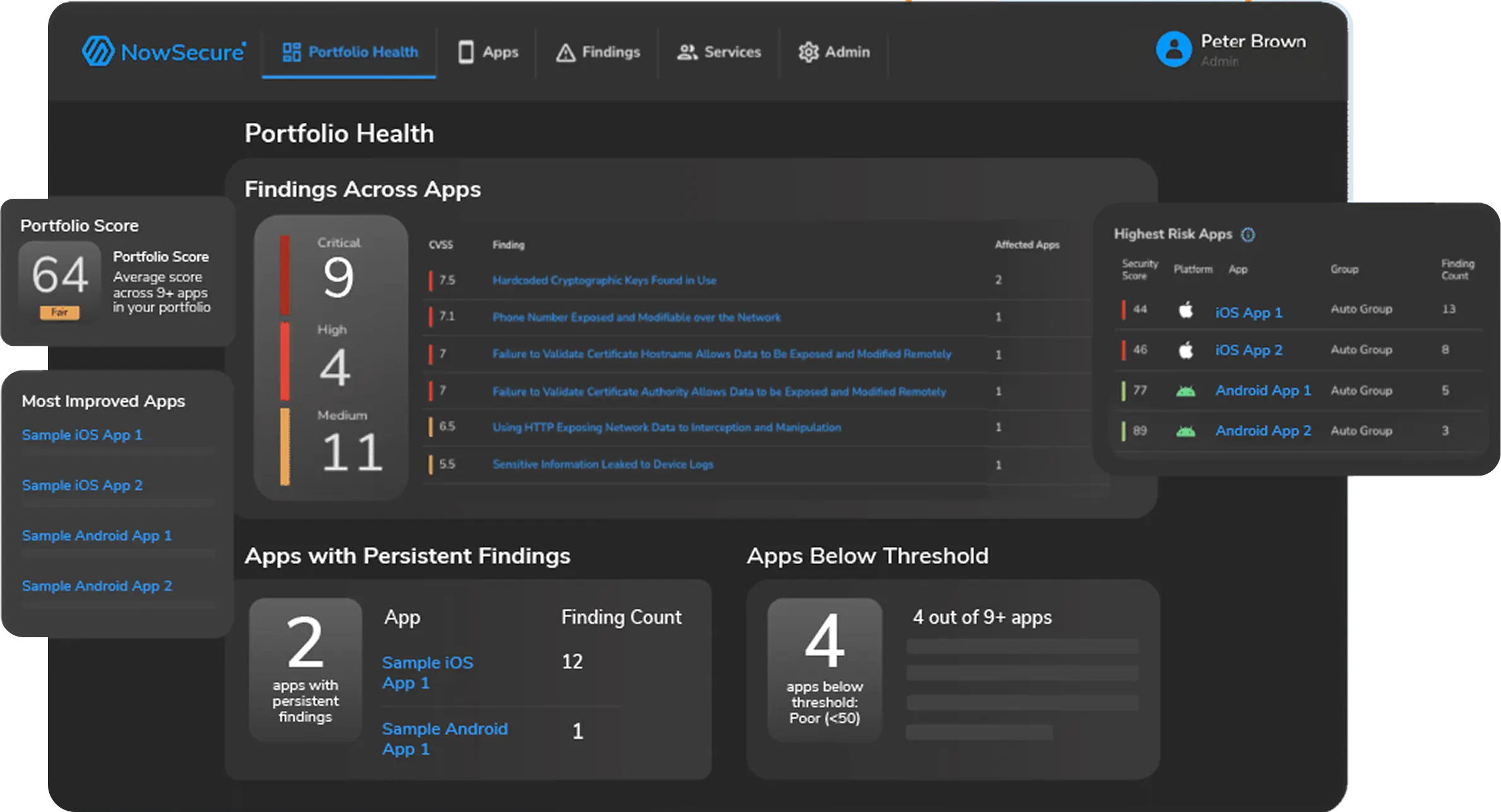
Start with one app you already ship and one workflow that handles sensitive data. NowSecure Platform flags embedded secrets in the compiled binary and shows which APIs the app contacts during authenticated testing on real iOS and Android devices. That gives your team a starting point for deciding where to review API permissions and where to scope deeper testing.
In an analysis of roughly 105,000 mobile app assessments, NowSecure found authenticated scans averaged 78% more sensitive-data findings per scan than unauthenticated scans. For high-impact workflows, NowSecure expert mobile penetration testers can assess how the app and its APIs enforce access after sign-in.
See what a shipped build reveals about your backend: Request a NowSecure Platform demo.

A genuine app can still send a request the signed-in user has no right to make.