Most security leaders know mobile app risk is growing. Turning that into a funded plan takes numbers, especially as AI features and third-party SDKs add exposure with every release. Here is a practical way to build that case.
To calculate the return on investment (ROI) of mobile app security testing, estimate the annual dollar value in six categories: incident exposure, risk reduction, compliance readiness, remediation speed, release velocity and team efficiency. Use your own numbers in each formula, add up the estimates you can support and bring the total to your budget conversation.
NowSecure built a guide to this model, The ROI of Mobile App Risk Management, and this post walks through it.
Where Can Mobile App Security Funding Come From?
You can fund mobile app security from budgets you already have. Mobile apps sit inside areas that security leaders currently fund, including AI security, third-party and supply chain risk and privacy and compliance.
That gives you more than one place to look for funding. Some teams find that a disproportionate share of their testing budget went to web apps and left little for mobile. Others have no baseline to show what mobile app security testing delivers. The six categories below turn mobile AppSec testing into numbers you can place against whichever budget owns the risk.
AI and third-party code drive that overlap. NowSecure's 2026 Mobile App Risk Management Survey of 485 senior security leaders found that 95% report deploying AI in their mobile apps. And 68% say more than half of their mobile code comes from third-party SDKs and libraries. Those organizations report security incidents at more than double the rate of organizations with less third-party code. IBM's 2026 breach research found that 21% of organizations studied experienced a security incident involving an AI model or application. Among those, 92% lacked proper AI access controls.
What Does Measured ROI Look Like?
A model only helps if the inputs are real. The Portfolio Health dashboard in NowSecure Platform calculates two figures for you: dollars saved compared with third-party pen testing and analyst hours saved compared with manual testing. A sample view from a demo account shows $220,000 in cost savings and 880 analyst hours reclaimed over 30 days. That account is for illustration only.
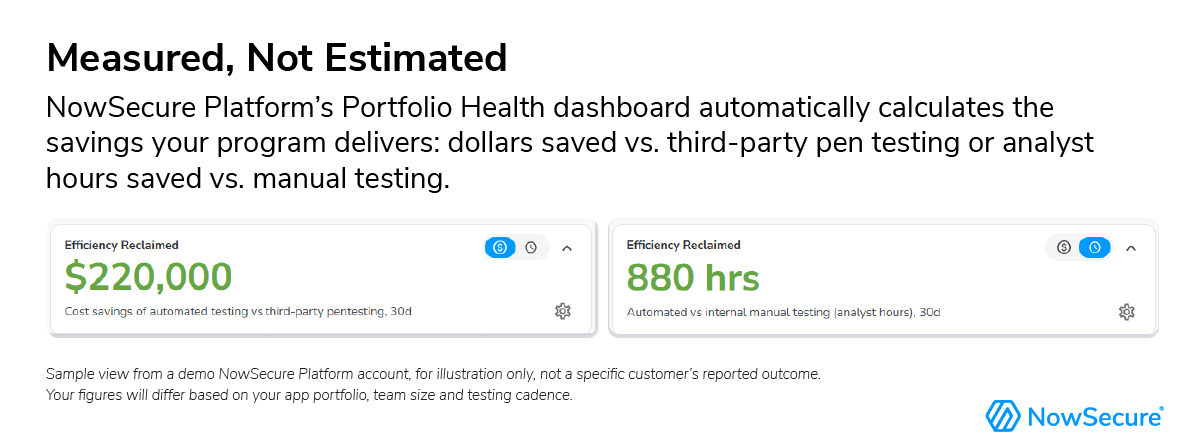
Your figures will depend on your app portfolio, team size and testing cadence.
Bell Canada reported these results from its own NowSecure program: 90% of critical security, privacy and compliance vulnerabilities caught before release, 60% less manual testing effort and faster releases once mobile security joined the CI/CD pipeline (NowSecure Bell Canada case study, 2025). These are one customer's reported results, not a guarantee for every organization. Get the one-pager: The ROI of Mobile App Risk Management
How Much Does a Mobile App Security Incident Cost?
Start here. Incident exposure is the number a board understands.
Verizon's 2025 Mobile Security Index looked at what happens after a mobile-related incident. Among organizations that had one, 47% report downtime, 45% report data loss and 40% report financial penalties or fines. And 22% report regulatory action. Of the organizations that had downtime, 63% describe the repercussions as major, up from 47% a year earlier.
For a dollar benchmark, IBM's 2026 Cost of a Data Breach Report puts the global average cost of a breach at $4.99 million and the US average at $11.50 million. IBM measures breaches in general, not only mobile, so treat the figures as a benchmark and not a prediction for your apps.
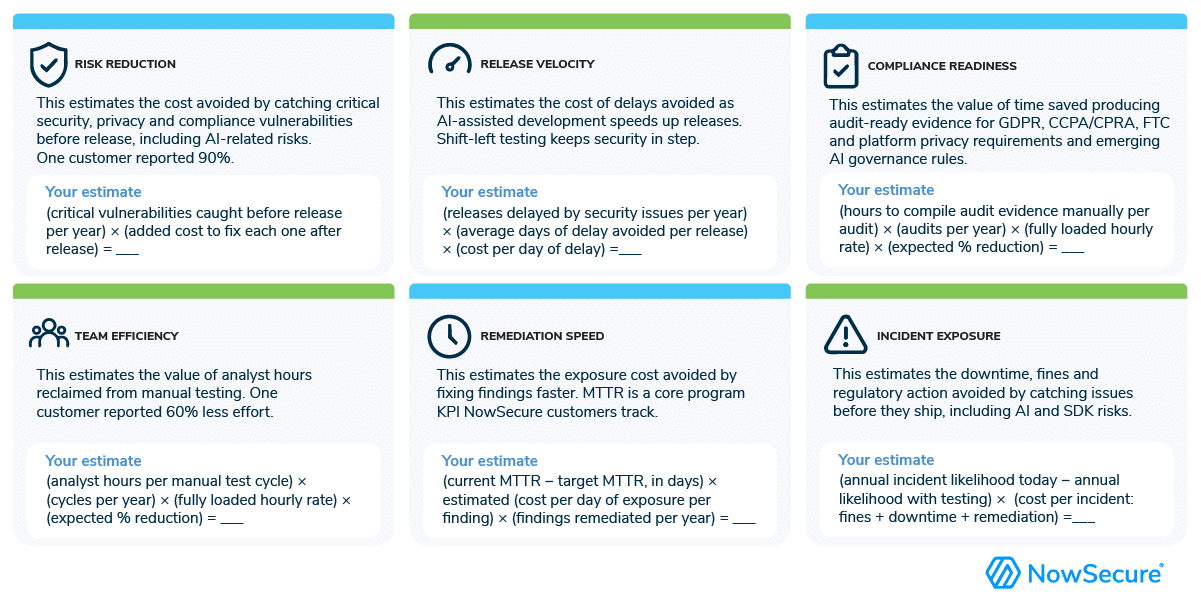
Formula: (annual incident likelihood today minus annual likelihood with testing) × (cost per incident: fines + downtime + remediation)
How Much Risk Does Testing Remove Before Release?
Risk reduction values the critical vulnerabilities you catch before an app ships, including AI-related risks. AI-assisted development increases the need to test every release.
Third-party SDKs add exposure that your developers did not write. Testing the shipped binary shows what the app contains and what data it moves, whoever wrote the code.
Formula: (critical vulnerabilities caught before release per year) × (added cost to fix each one after release)
What Does Compliance Readiness Add to the Business Case?
Auditors, regulators and customers all ask for evidence. Compliance readiness values the time you save producing audit-ready evidence for GDPR, CCPA/CPRA, FTC and platform privacy requirements, plus emerging AI governance rules.
A recognized standard makes that evidence easier to defend. NowSecure tests against the OWASP MASVS, so findings map to a framework that auditors and security teams already know. Some buyers also write an objective standard into their buying criteria, so every vendor faces the same checklist. See how it works on the OWASP mobile app security testing page.
Formula: (hours to compile audit evidence manually per audit) × (audits per year) × (fully loaded hourly rate) × (expected % reduction)
How Does Faster Remediation Reduce Exposure?
Every day a known finding stays open adds exposure. IBM's 2026 report puts the average time to identify and contain a breach at 247 days, up from 241 days in 2025. The same logic applies to fixing app findings. NowSecure customers track mean time to remediate (MTTR) as a core program KPI, and it is the easiest number to baseline from your ticketing data.
Formula: (current MTTR minus target MTTR, in days) × (estimated cost per day of exposure per finding) × (findings remediated per year)
How Do You Value Faster Releases?
AI-assisted development speeds up releases, and security testing has to keep pace. A late finding can delay a release, and that delay costs money. Release velocity estimates the cost of those delays. Shift-left testing in the CI/CD pipeline moves findings to the point where developers can fix them before the release date.
Ask your development leaders two questions. How many releases slipped last year because of security issues, and by how many days?
Formula: (releases delayed by security issues per year) × (average days of delay avoided per release) × (cost per day of delay)
How Do You Value Team Efficiency?
Manual testing is slow and expensive, and many teams outsource it to cover the gap. Managing test devices adds to the load. Team efficiency counts the analyst hours that automation reclaims. A quarterly manual test covers one point in time. Automated testing covers every release.
Bell Canada reports 60% less manual effort. Your own number depends on how many hours each manual cycle takes today.
Formula: (analyst hours per manual test cycle) × (cycles per year) × (fully loaded hourly rate) × (expected % reduction)
How Do You Bring the Estimate to a Budget Conversation?
Exclude overlapping benefits so you count each saving once, then add up the estimates you can support with your own data. Treat the total as a directional estimate for your next planning review. You can model the categories in any order. Lead with the ones your approver cares about most. Then match each to the budget that owns the risk, such as AI security or third-party risk for incident exposure and risk reduction and privacy or compliance for compliance readiness.
To express your estimate as an ROI percentage, subtract the annual program cost from the estimated annual value, then divide by the annual program cost and multiply by 100. Include software, services and internal labor in your program cost, and count each benefit only once.
ROI (%) = [(annual value − annual program cost) ÷ annual program cost] × 100
Set your baseline now. Record your current testing cost, MTTR and open critical findings, then track the same numbers after you invest. A one-page summary that sets your estimate beside the alternatives makes the approver's job easier. When renewal time comes, reviewers will ask what changed, and NowSecure Platform reporting can summarize the vulnerabilities fixed and the savings over time.
Build Your Estimate
Download The ROI of Mobile App Risk Management to model your numbers and bring the total to your next budget conversation.

"Incident exposure is the number a board understands."