Why Line of Business and the CISO can finally be on the same team.
AI is rapidly transforming how mobile applications are built. One emerging approach, often referred to as vibe coding — AI-assisted generation of mobile applications using natural language prompts — is enabling teams to create apps faster than ever before.
But speed does not equal security.
In Part 1 of our AI vibe coding for mobile apps blog series, we asked a critical question: Does AI-powered development make mobile app creation easier and secure?
The answer was clear: easy does not mean secure.
In Part 2, we showed how a recursive mobile app security testing (MAST) loop can dramatically improve outcomes, turning AI-generated apps into software that can withstand real-world threats.
Now, the conversation shifts from improvement to control.
How do CISOs ensure every mobile app — AI generated, internally developed or third-party — meets a consistent security standard without slowing the business down?
That is where NowSecure Platform, a mobile application security testing (MAST) solution that combines automated testing with policy-driven enforcement, becomes essential.
The real risk isn’t a single insecure app; it’s uncontrolled application growth without visibility and enforceable security governance.
Why AI-Generated Mobile Apps Introduce Hidden Risk
AI-generated mobile apps often function as expected but contain hidden vulnerabilities, data leakage risks and unintended surveillance behaviors that impact how sensitive data is transmitted and secured.
These issues are not rare edge cases. They are common violations of the OWASP Mobile Application Security Verification Standard (MASVS), the industry benchmark for mobile app security.
Our analysis shows that more than 95% of mobile apps fail to meet even baseline OWASP MASVS requirements, particularly in areas related to network security, platform protections and data handling.
These risks stem not just from code, but from how mobile apps are configured and behave at runtime.
Common examples include:
- Cleartext traffic left enabled during development
- Weak or incomplete TLS configurations
- Missing platform protections like App Transport Security (ATS) on iOS
- Implicit trust in backend systems without proper validation
These are precisely the types of issues that mobile application security testing (MAST) is designed to detect, yet they are frequently missed by traditional AppSec tools.
The real risk isn’t a single insecure app; it’s uncontrolled application growth without enforceable security governance.
Why This Matters for CISOs
Unlike traditional web applications:
- There are few CVEs for mobile apps
- Risks are primarily zero-day issues
- They occur frequently in production environments
And importantly: Attackers are already looking for them.
This creates a dangerous reality: Your organization is using and releasing mobile apps with unmeasured, unmanaged risk exposure.
Why Traditional AppSec Fails Mobile Governance
Most enterprise AppSec programs were built for web and backend systems, not mobile apps.
As a result, they rely on tools that:
- Analyze source code instead of compiled mobile binaries
- Focus on known vulnerabilities (CVEs)
- Lack visibility into runtime behavior and platform controls
- Are not mobile app domain specific
- Do not inspect third-party components
Mobile apps operate differently:
- Security enforcement happens at the app and OS level
- Risk is driven by configuration and runtime behavior
- Data protection depends on real-world component, API and network interactions
The Governance Gap
This creates a critical blind spot:
- Apps pass security testing
- Reports appear clean
- Real mobile risk remains undetected
This is not just a false negative tooling issue, it’s a governance failure.
What This Looks Like in Travel and Hospitality
Consider a mobile app used by an airline or hotel brand.
These apps routinely handle:
- Customer identity and loyalty accounts
- Booking and payment transactions
- Real-time itinerary and travel data
If mobile data-in-transit protections are misconfigured (for example, weak TLS enforcement or missing platform controls) an attacker on public Wi-Fi network could:
- Intercept session tokens or API responses
- Access or modify booking details
- Expose customer personal and payment information
The Business Impact
This isn’t just a technical flaw. It creates real enterprise risk:
- Account takeover and loyalty fraud
- Disrupted bookings and customer service failures
- Regulatory exposure (PCI, GDPR, regional privacy laws)
- Brand damage during high-visibility travel events
For organizations in travel and hospitality, where mobile apps are the primary customer interface, these failures directly impact revenue, customer trust and operational continuity.
These risks are rarely detected by traditional AppSec tools because they stem from how mobile apps behave in real-world environments, not just how they are written.
The Answer: Measurable, Enforceable Security Standards
The breakthrough is not just better testing, it’s policy-driven mobile application security governance.
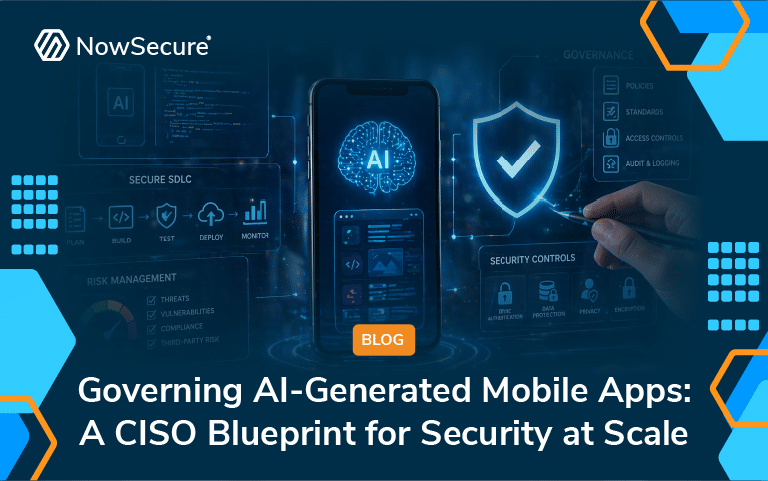
With the NowSecure Platform Policy Engine, organizations can define, measure and enforce a minimum acceptable security standard for every mobile app.
What Is a “Minimum Bar” Policy?
A minimum bar policy ensures that:
No application can be released unless it meets a defined mobile application security testing threshold.
Example:
- “No mobile app ships with a security score below 85.”
Within NowSecure Platform, this policy is enforced automatically through continuous mobile application security testing, ensuring that every app is evaluated against real-world risk conditions, not just static code checks.
How This Aligns the Organization
- The CISO defines acceptable risk thresholds
- Development teams iterate to meet the thresholds.
- The platform enforces compliance automatically
This shifts security from:
- Manual review → Automated enforcement
- Subjective risk → Quantifiable metrics
- Bottlenecks → Scalable governance
This model aligns with continuous mobile security testing in modern mobile DevSecOps pipelines and new vibe coding environments, where security is embedded directly into the development and release process.
The Proof: From High Risk to Enterprise-Ready
After applying the recursive testing loop from Part 2, PanoPrompt v1.0.4 achieved:
Security Score: 96 (Excellent)
A transformation from high risk (25) to enterprise-ready (96) demonstrates a repeatable model for organizations adopting AI-driven development. No mobile app security, data security or AI security knowledge is needed, just let NowSecure and the AI development tool do the work.
From unmanaged risk to policy-driven assurance.
Why This Finally Aligns Security and the Business
For CISOs, this model resolves a long-standing tension:
| Business Goal | Security Requirement |
| Move fast | Enforce controls |
| Innovate with AI | Prevent data exposure |
| Scale app development | Maintain visibility and compliance |
With policy-driven mobile application security testing:
- The business gets speed and autonomy
- Security gets control and assurance
- Leadership gets measurable risk reduction
What Is Vibe Coding and Is It Secure?
Vibe coding refers to the use of AI tools to generate mobile application code from natural language prompts, accelerating development without requiring deep manual engineering.
While it improves speed, it introduces significant risks because:
- AI-generated mobile apps often lack mobile-specific security controls
- Default configurations may violate OWASP MASVS requirements
- AI lacks awareness of runtime mobile behavior and data flows
Key takeaway:
Vibe coding accelerates development — but without mobile application security testing (MAST), it frequently produces apps with exploitable vulnerabilities..
How Can CISOs Secure AI-Generated Mobile Apps?
CISOs can secure AI-generated mobile apps by implementing:
- Continuous mobile application security testing (MAST)
- Automated policy enforcement using platforms like NowSecure Platform
- Measurable security thresholds aligned to OWASP MASVS standards
This ensures:
- Real-world vulnerabilities are identified before release
- Security policies are consistently enforced
- Risk is quantified across all mobile applications
A Message to Corporate Leadership
AI-driven development is not something organizations can or should block.
But it must be governed.
The organizations that succeed will:
- Define clear security policies
- Enforce them automatically
- Measure risk continuously
Final Takeaway for CISOs
AI is accelerating mobile development but also expanding the attack surface. AI security presents an opportunity for integrated and automated security that previously could not be achieved.
To stay ahead, CISOs must move from:
- Reactive testing → Continuous validation
- Manual reviews → Automated enforcement
- Assumed security → Measured assurance
- Independent security → Integrated security
By integrating mobile application security testing into AI workflows, organizations can scale innovation without scaling risk.
Don’t fear the vibe. Govern it. Verify it. Win with it.