Mobile App Security for Retail and Hospitality
Secure the apps your customers trust to book, buy, and reserve
NowSecure turns the mobile app into an intelligence source for enterprise security, privacy, AI governance, and data protection.
Why it is different
Mobile application risk Management Adds app-level evidence to broad risk platforms
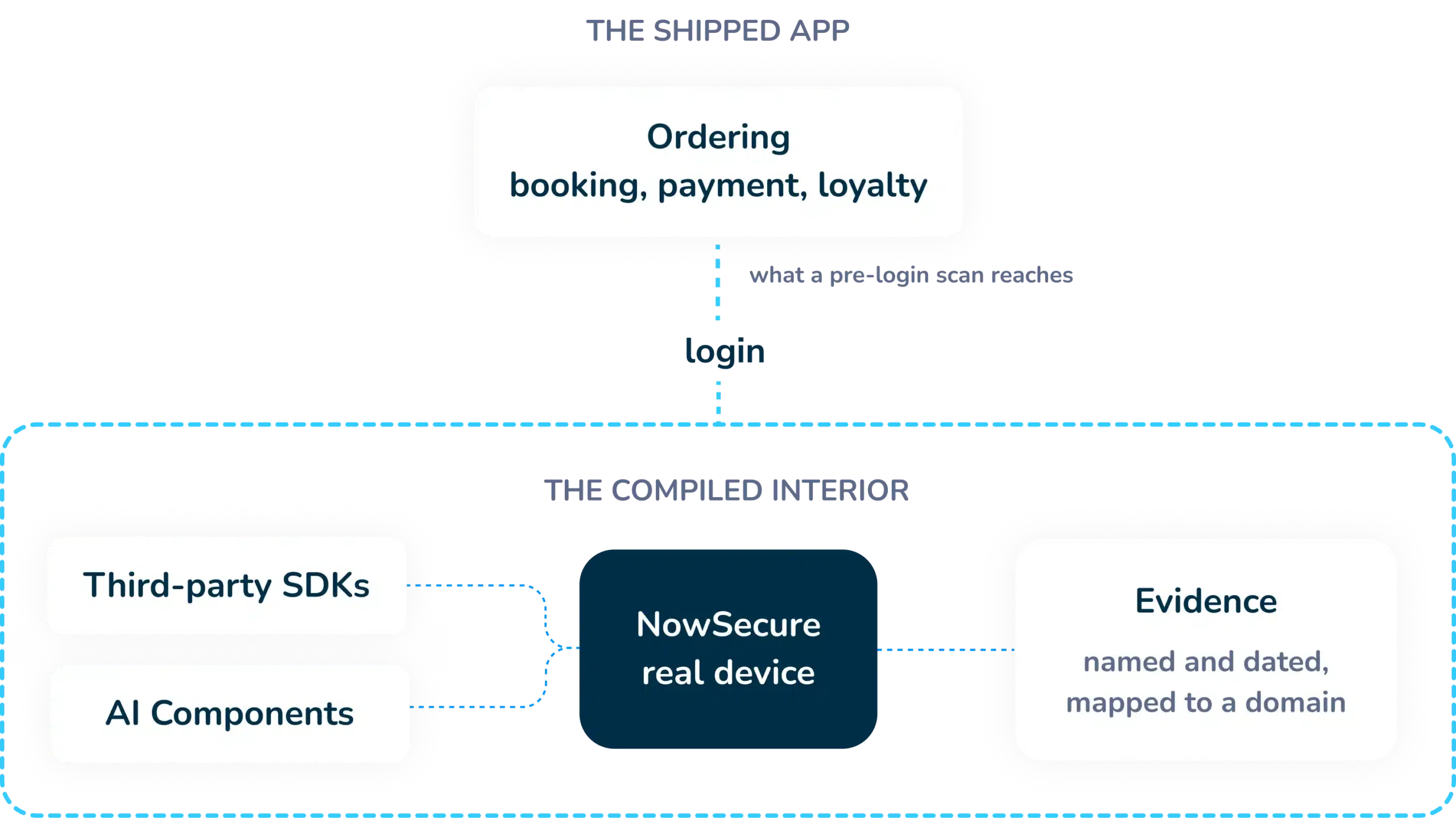
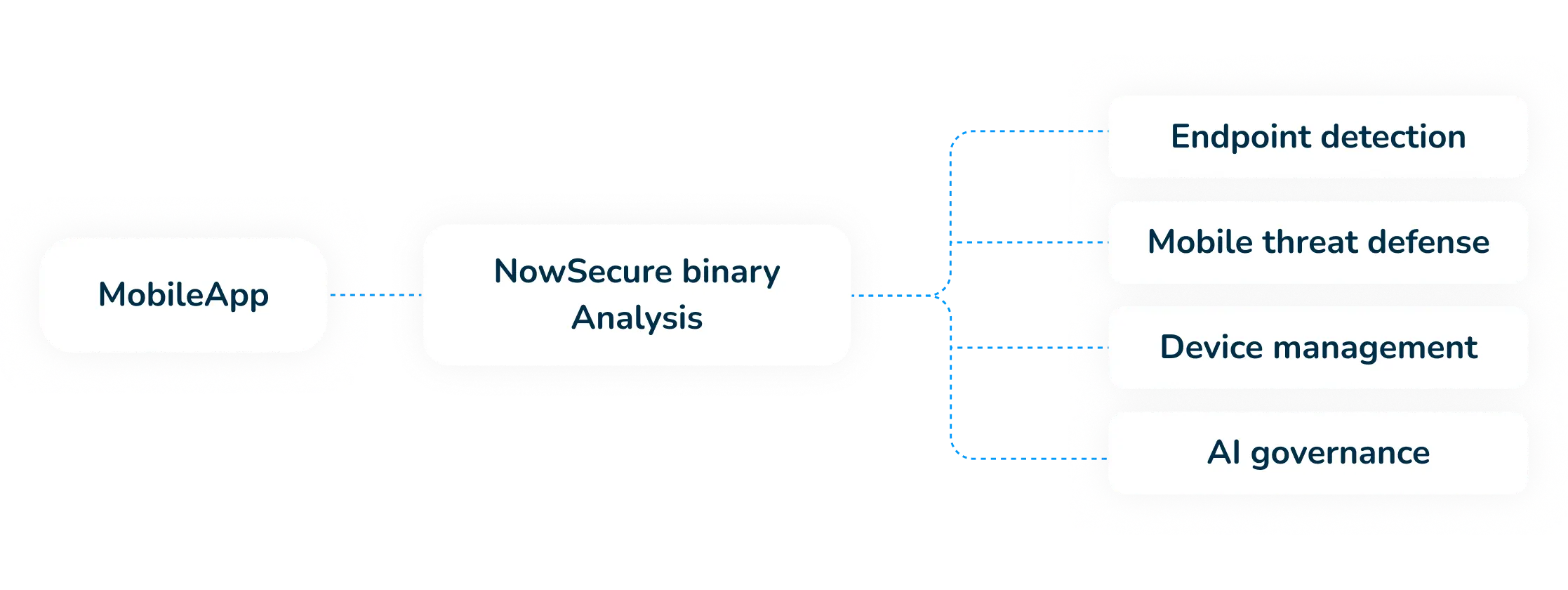
Broad application risk platforms aggregate cloud, endpoint, API and repository risk. Mobile application risk management adds binary and runtime evidence from the shipped app after login.
NowSecure provides mobile evidence that security, privacy and AI governance teams can use with
broader enterprise risk data.
| What a broad application risk platform reaches | What NowSecure mobile application risk management reaches |
|---|---|
| Cloud, endpoint, API and repository risk | The compiled binary, tested on a real device after login |
| Information supplied through a vendor questionnaire | AI components and SDKs present in the shipped build. Suspendisse. |
| Findings from surfaces available before login | Runtime behavior in ordering, booking, payment and loyalty. |
Which apps you own
Securing the mobile apps you build and the mobile apps you use
Retail organizations rely on two distinct mobile app ecosystems: the custom apps built to drive
customer commerce, and the third-party apps employees use to run the business. Both operate outside the enterprise perimeter on devices you do not control. NowSecure delivers full-spectrum visibility, continuous testing, and automated risk governance across both footprints.
Apps You Build
First-Party Mobile AppSec & DevSecOps
- DevSecOps Integration: Embed automated static, dynamic, and interactive security testing (SAST/DAST/IAST) directly into CI/CD pipelines to catch flaws before code reaches production.
- Real-Device Dynamic Testing: Validate authenticated ordering, payment, and loyalty flows on physical iOS and Android devices to ensure business logic and controls execute properly.
- Standards & Compliance: Benchmark releases against OWASP MASVS v2.1.0 and PCI DSS standards, verifying data encryption, session handling, and permission use.
- Expert Penetration Testing: Deep-dive manual security assessments for high-profile releases and complex mobile app architectures.
Apps You Use
Third-Party Mobile App Risk Management
- Zero-Trust Supply Chain Vetting: Assess commercial off-the-shelf (COTS) and workforce apps continuously without waiting for source code access or vendor questionnaires.
- Store and Published Binary Analysis: Evaluate mobile apps directly as published to public or private app stores, auditing the compiled binary for actual behavior.
- SDK & Shadow AI Visibility: Automatically detect hidden third-party SDKs, background data tracking, unannounced updates, and unvetted AI inference components.
- Enterprise Risk Integration: Feed mobile threat telemetry directly into EDR, MTD, and enterprise governance platforms to protect corporate devices and guest networks.
PROOF
A mobile app release can introduce risk between tests
THE CADENCE
Retail dev teams ship 12 to 26 app updates every year (every 2 to 4 weeks) to support new features, loyalty updates, and SDK patches.
the gap
44% of retail organizations test mobile apps no more than once a quarter, leaving months of releases unexamined.
The requirement
A quarterly test only covers one snapshot in time.
Analyzing the published binary continuously ensures every build shipped to the app store is verified.
The retail data behind these figures. NowSecure 2026 Mobile App Risk Management Survey. The figure represents the surveyed retail subgroup.
The exposure
Mobile app AI governance demands binary & runtime proof
AI Governance for Mobile Apps: Know where AI exists, what it can access, what it is doing, and produce evidence to govern it.
Static policies alone cannot provide complete assurance over dynamic AI behavior; they should be combined with runtime and release-level evidence. NowSecure provides continuous, real-device evidence to verify where AI operates, what customer data it touches, and where that data flows.
53% of the 50,000+ mobile app builds analyzed monthly by NowSecure contain embedded AI components, frequently introduced through third-party SDK updates without explicit security review.
NowSecure replaces vendor assumptions with definitive, build-level evidence across six critical AI governance dimensions:

What AI is present
Binary analysis lists detectable AI models, SDKs and on-device inference calls compiled into the app.

What data it can acces
An authenticated run records the permissions, identifiers and customer data the component touches.

Where that data can go
.Captured traffic identifies SDK data-flow destinations.

What it does at runtime
Instrumentation identifies executed code paths.

What changed between releases
Analysis of each build identifies
new or changed components.

What evidence a governance team can use
Findings include OWASP MASVS v2.1.0 domain names
For high-risk or obfuscated apps, targeted expert reverse engineering extends the evidence depth.
The exposure
Pre-login scans stop where mobile risk begins
Unauthenticated scans stop at the login boundary and miss critical post-login behavior. But in retail
and hospitality, the highest-value data, payment rails, and third-party tracking execute exclusively behind authentication. Passing an unauthenticated scan only proves your front door is locked - it reveals nothing about what happens inside the house.
| What surface scans reach (pre-login) | What real-device analysis exposes (post-login) |
|---|---|
| Welcome & Marketing Screens. Static forms, public assets, and App Store metadata. | Stored Value & Transactions. Loyalty reward balances, stored payment tokens, and BOPIS (buy-online-pickup-in-store) order flows. |
| Public API Endpoints. Basic store locators and unauthenticated network traffic. | Sensitive Customer PII. Guest names, reservation histories, saved addresses, and exact physical location telemetry. |
| Declared Permissions. Static manifest declarations without runtime execution context. | Active Third-Party SDK Leaks. Background data sharing, unannounced SDK destinations, and unauthorized telemetry calls. |
| Compiled Package Footprint. Static code markers without context on dynamic model execution. | Runtime AI Data Flows. Embedded AI assistants and LLM inference calls accessing authenticated app storage and APIs. |
Third-party SDKs and AI components create separate mobile application risks.
Third-Party SDKs Move Customer Data Out of the App.
Sensitive data can reach third-party SDK destinations. Permission use can expose location data. Binary and runtime analysis identify the SDKs in the shipped build, the permissions they use and the destinations they contact.
AI Components Reach Customer Data Inside the App
Customer data can reach external AI services. The combination of binary analysis, static analysis and authenticated dynamic testing can help identify which ones they touch. AI components can access app permissions, identifiers and customer data. Binary analysis identifies detectable AI components in the build. Authenticated testing records their runtime access and traffic.
How Real-Device Analysis Reaches Past the Login Wall
the mechanism
Authenticated real-device analysis tests post-login mobile app flows
Mobile Risk: Find and validate what is happening inside the mobile application.
Validate actual runtime behavior and compiled components using physical hardware, dynamic instrumentation, and automated binary disassembly.
How Each Analysis Layer Drives MASVS Domain Evidence

Mobile intelligence
Integrate mobile risk intelligence where your teams already work
Transform binary and runtime findings into continuous telemetry for EDR, MTD, ASPM, SIEM, and GRC
platforms. Eliminate data silos by correlating app-level risk with enterprise device telemetry in real time.
Mobile Intelligence: Turn what NowSecure discovers inside the mobile app into actionable
intelligence for security, privacy, AI governance, and data-protection systems.
| Evidence extracted | Stack integration | Automated outcomes |
|---|---|---|
| Payment & loyalty data flows | EDR / MTD: CrowdStrike, SentinelOne | Automate conditional device access |
| Third-party SDK behaviors | ASPM / SIEM: Brinqa, Splunk | Observe unvetted external AI calls |
| Shadow AI & LLM traffic | MDM / IAM: Intune, Workspace ONE | Stop unauthorized data exfiltration |
The NowSecure Intelligence Sharing Program makes this intelligence available to security vendors and AI-driven platforms.
NowSecure keeps customer testing environments separate from the intelligence repository, and customer applications, configuration and scan results never enter it.
Enterprise Data Isolation Guardrail.
Customer environments are strictly segregated. Your proprietary code, build configurations, and scan results remain completely confidential and are never ingested into public threat repositories or shared partner feeds.
What enterprise teams achieve

Detect Vulnerable SDKs
Audit third-party library risk across managed and BYOD employee fleets.

Surface Ungoverned AI
Flag mobile apps calling external AI services without security or privacy oversight.

Prevent Data Exfiltration
Identify unauthorized background tracking and abnormal system permission abuse.

Automate Conditional Access
Block risky app execution or restrict network access based on live threat scoring.
Who we serve
Mobile app security evidence for commerce teams
NowSecure applies real-device testing to apps used by large-format and specialty retail, quick-service and fast-casual restaurants, hotels and hospitality groups, travel and transportation, digital marketplaces, and gaming and ticketing.
Hospitality portfolios are split differently from one group to the next. NowSecure tests each app a group ships and reports what that binary holds, so booking, check-in, guest data and payment are covered wherever they sit.
Executive Real-Device Audit Reports
Deliver board-ready security attestations before Black Friday, Cyber Week, or peak holiday travel freezes, validating that authenticated payment rails, loyalty stored value, and customer PII are fully protected on live devices.
Unified Domain-Level Compliance Metrics
Standardize findings across complex retail and hospitality portfolios using a single evidence baseline mapped directly to OWASP MASVS v2.1.0 and PCI DSS 4.0 requirements across both iOS and Android.
Build-Level Release Attestations
Generate automated pass/fail verification directly within CI/CD pipelines (GitHub, Azure DevOps, Jira) tied to the exact Git commit, maintaining continuous security validation even during strict code freezes.
Continuous AI & SDK Lineage Records
Provide audit committees and privacy officers with definitive, per-build records detailing every embedded AI inference model, third-party SDK destination, and background permission call across all published builds.
Customer evidence
Mobile app security in the Caribou Coffee and camelot release processes
Used by over half of its rewards program customers, Caribou Coffee's mobile app has become core to the business.

"One of the best things about moving to NowSecure is not having to fan through a 110-page security audit to figure out what bugs and security issues you need to address."
Eric Caron
Senior Director of IT Solution
Caribou Coffee
NowSecure Platform automates security testing throughout our DevSecOps pipeline from the build process all the way to issues ticketing. When we have security issues the dev team reviews them, fixes the bugs and provides a new build."
Dmytro Bezpalyi
Security Engineer
Camelot Lottery Solutions
Standards
Built on ISO acredited lab testing and OWASP standards
COMPLIANCE & ACCREDITATION
NowSecure maps every mobile vulnerability directly to recognized global security frameworks and operates an accredited testing facility to guarantee audit-ready precision. This page highlights four MASVS domains most relevant to the examples shown; MASVS also includes CRYPTO, AUTH, PLATFORM, and CODE requirements.
OWASP MASVS v2.1.0 organizes mobile application security requirements into named control groups.
| OWASP MASVS v2.1.0 domain | What it governs in a commerce app |
|---|---|
| MASVS-STORAGE | Cardholder data, stored-value loyalty balances, and tokens at rest on the device. |
| MASVS-NETWORK | Data in transit, TLS configurations, and dynamic SDK traffic destinations. |
| MASVS-PRIVACY | Customer PII collection, session tracking, and background permission usage. |
| MASVS-RESILIENCE | Resistance to reverse engineering, root/jailbreak detection, and code tampering. |
ISO/IEC 17025:2017 Accredited Laboratory & PCI DSS 4.0 Alignment
NowSecure operates an ISO/IEC 17025:2017 accredited testing laboratory (A2LA Cert. No. 7003.01) covering MASA and OWASP MASVS Level 1 assessments. PCI DSS v4.0 emphasizes ongoing security processes. Mobile testing can provide supporting evidence for applicable PCI DSS requirements, subject to the cardholder-data environment, scope, and assessor interpretation.
The accreditation is A2LA Cert. No. 7003.01, valid to 2027-08-31, covering the MASA and OWASP MASVS Level 1 assessment service. The same laboratory delivers the deeper binary and runtime testing described above.
Customer evidence
Assess your commerce apps before the next peak window
Get a complete per-app inventory of the third-party SDKs and AI components running inside your published iOS and Android binaries, backed by real-device dynamic evidence.

Validate Authenticated Flows
Test login, stored value, checkout, and loyalty mechanisms on live hardware.

Expose Hidden SDK Destinations
Identify unauthorized background telemetry and dynamic data sharing.

Audit Embedded AI
Map on-device inference models and external LLM API calls across every release.
Coverage estimator
Estimate your mobile app security coverage gap
Model how much of your mobile portfolio enters your current assessment process. Adjust four operational inputs to see annual first-party elease coverage and the number of third-party apps outside that process.
See what NowSecure Agentic AI surfaces in your mobile app portfolio.
Start with your highest-priority apps. See what AI surfaces from day one.
Resources
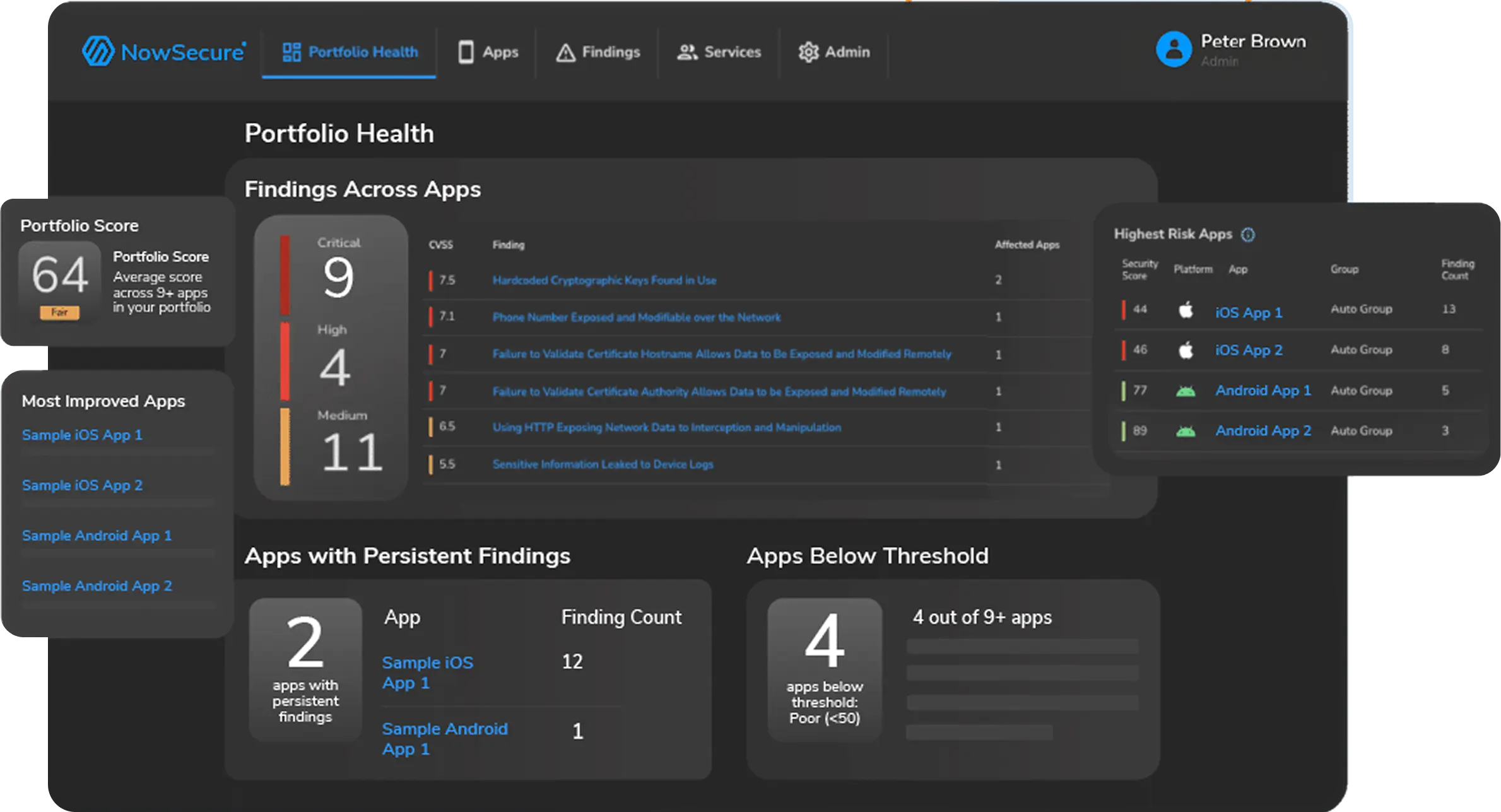
Mobile Application Risk Management Resources
Frequently asked questions about mobile application security testing
Have more questions? Get in touch with our team.